Whole-Wheat Noodles: Is the Finest Bran Always Better?
A whole-wheat noodle brief should specify the desired cooked result. Learn why the finest bran is not an automatic choice and what the current catalog confirms.
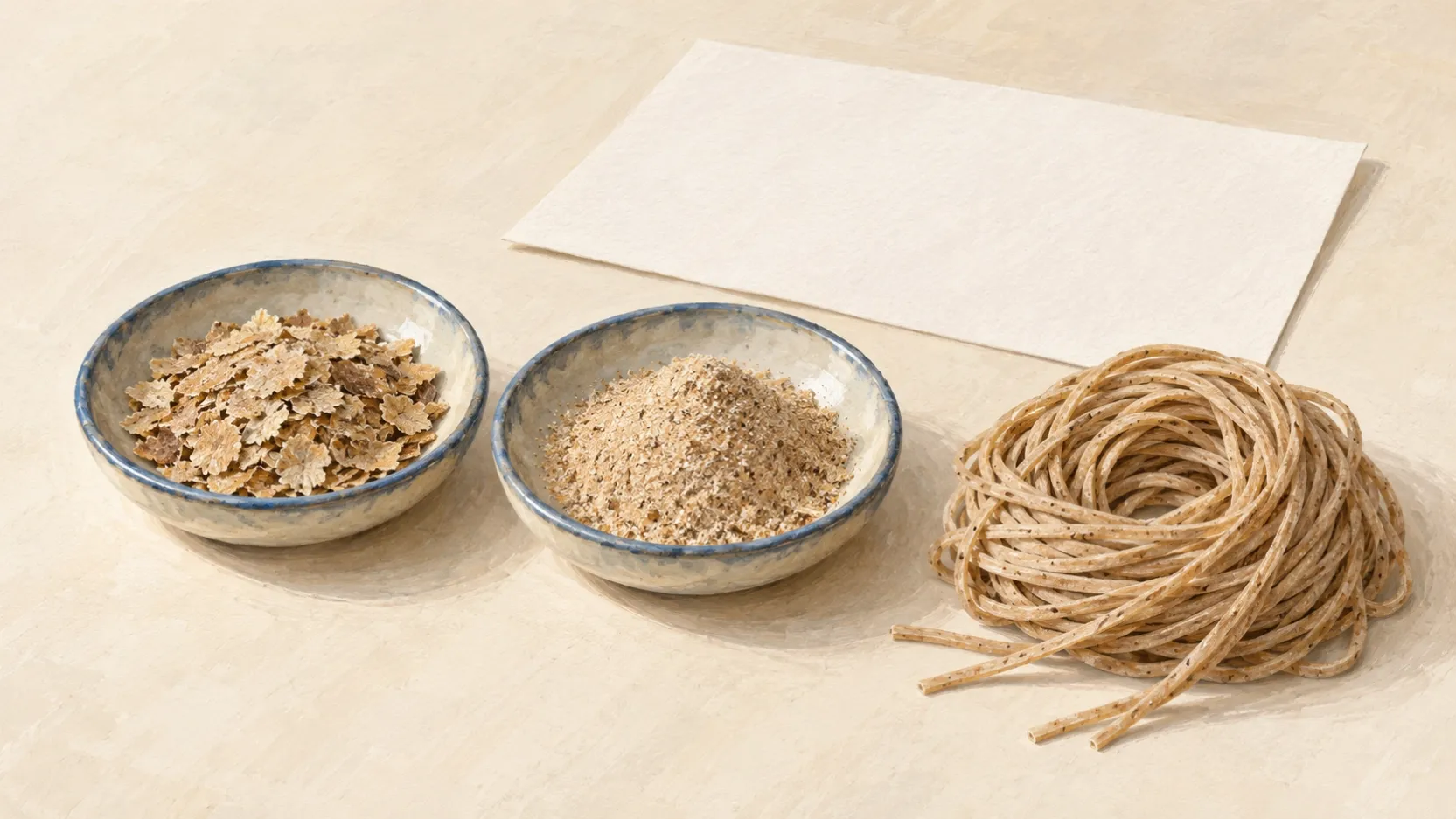
AI-generated conceptual illustration of coarse and fine bran textures beside generic noodles. It does not depict an actual Noodle House whole-wheat product or establish ingredient proportions, certification or measured performance.
If your purchasing brief already requires whole-wheat noodles, avoid making “the finest bran available” an automatic acceptance condition. Decide what the finished noodle needs to do in the intended dish, then ask how a supplier's proposed formulation addresses that requirement. A grinding description should help explain a candidate, rather than decide the order by itself.
This is a purchasing guide for evaluating a whole-wheat requirement. It does not identify a confirmed Noodle House Food whole-wheat SKU or offer a factory formulation.
What the bran-size experiment shows
In a 2022 study by Lai and colleagues, researchers combined refined flour and differently ground bran from a specified wheat cultivar to make reconstituted whole-wheat flour. They prepared experimental noodles and measured their texture after cooking. As bran particle size decreased, hardness, springiness, cohesiveness and resilience initially increased and then declined.
The authors discussed changes in the gluten network as part of the explanation. Their results describe that particular flour, bran and laboratory preparation. They do not provide a universal particle-size specification for commercial dried noodles, or a performance result for our products.
The useful purchasing implication is limited: ordering the smallest particles cannot be assumed to maximize every desired texture property. The study does not decide which cooked bite your customers prefer.
Specify the result before the milling description
A request such as “whole-wheat noodles with the finest possible bran” mixes a product requirement with an unverified manufacturing preference. Keep the whole-wheat requirement explicit, but replace the automatic grinding preference with the eating characteristics you actually need.
For example, a hypothetical foodservice buyer might want a noodle that remains distinct when lifted from a soup bowl and has a noticeable, acceptable bite. Those are application requirements. “Finest bran” does not express either one clearly enough for a supplier to agree what success means.
Write the intended noodle form and dish into the brief. If appearance matters, describe the acceptable appearance separately from the cooked bite. Do not make a finer-looking sample the winner before deciding whether it meets those stated requirements. A buyer can prefer a particular appearance without presenting that preference as proof of superior texture.
Keep formulation changes visible during the discussion
Suppose a supplier proposes two whole-wheat candidates and describes one as more finely milled. Ask whether bran size is the only stated difference, or whether the flour blend, formulation or noodle dimensions also differ. The answer determines what can reasonably be attributed to milling.
If several features changed together, describe the samples as two different formulations. Avoid recording the preferred result as evidence that one bran size caused the difference. That distinction matters when the supplier later proposes a replacement: approving one finished formulation is not approval for every product carrying the same milling description.
For repeat purchasing, link the accepted sample identifier to the supplier's agreed product description. Ask to be told when that description changes. Where the supplier has no particle-size information, record that field as unavailable; it does not become a guessed specification. The commercial discussion can still establish whether a documented whole-wheat candidate is available and suitable for evaluation.
Check what the current catalog actually supports
Our Dried Noodles product page lists wheat flour, water and salt. The words “wheat flour” alone do not establish that this product meets a whole-wheat brief. Treat this catalog entry as a reference for the listed product, with the whole-wheat requirement unresolved.
If your original request says “atta noodles,” retain that wording and clarify the required product description instead of silently replacing it with “whole-wheat noodles.” This guide makes no finding that the two requests are interchangeable.
Contact Noodle House Food with the required grain description, noodle form, intended dish and pack format. Ask whether a matching product can be documented before discussing a sample or order. A whole-wheat requirement should remain visible throughout that enquiry; this article does not confirm availability, custom development or a preferred bran size.