Sep 29, 2026Buying Guides
Egg Roll Packaging Trials: Define Breakage Before Testing
Define damage criteria and separate broken-roll counts from affected-pack counts before comparing egg roll cookie packaging trials.
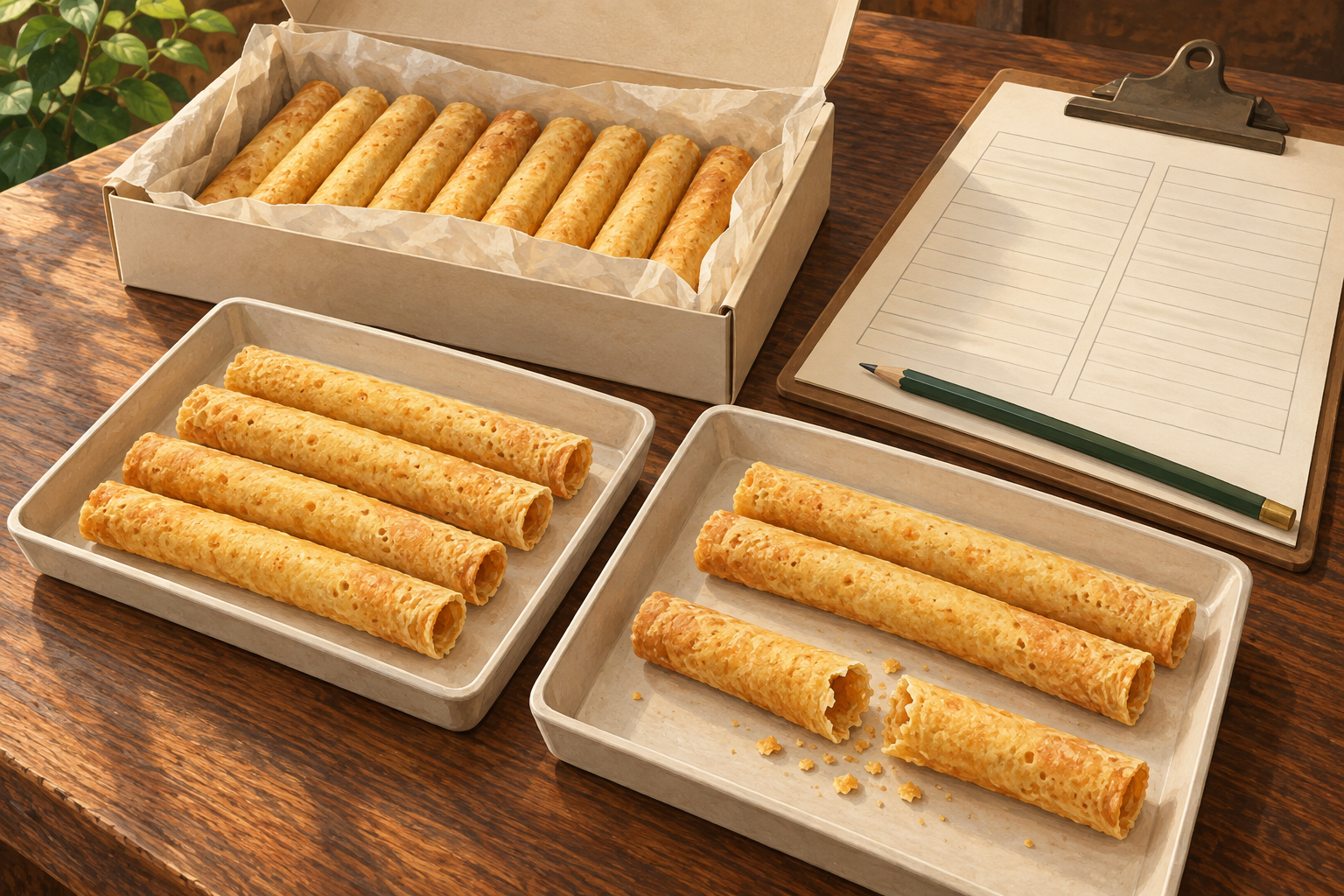
AI-generated editorial illustration of breakage recording; not an actual company test, shipment or packaging specification.
A report saying “7.5% breakage” is incomplete until the buyer knows what was counted. Was it individual biscuit rolls, retail packs containing a broken roll, or damaged outer cartons? Those figures can describe the same trial and still be very different.
For buyers evaluating Chinese egg roll cookies, agree the damage definitions and reporting units before comparing packaging options. This guide concerns crisp sweet biscuit rolls. Keep different snack shapes and SKUs in separate records.
Agree what counts as damage
Write a short illustrated classification sheet with the supplier or testing provider. Decide how to record a roll separated into sections, a visible crack, a chipped end and loose crumbs. Include photographs of borderline examples so two inspectors can apply the same rule.
Define food damage separately from packaging damage. A dented outer carton, torn retail wrapper and fractured biscuit are three observations. Record each without assuming that one proves another.
Agree who decides acceptance and the limits for each category before the trial. There is no acceptance percentage supplied by this guide. Retail presentation requirements and the proposed evaluation method need buyer-specific agreement.
ISTA's design and testing guidance explains that most of its protocols require product damage tolerance and allowable package degradation to be determined before testing. It also calls for samples that closely represent the intended product and packaging. That principle supports defining the decision before collecting results; it does not establish that a supplier has performed an ISTA test.
Keep the counting unit visible
Use a separate calculation for each question:
- Broken-roll percentage: original rolls classified as broken divided by original rolls assessed, multiplied by 100.
- Affected-pack percentage: inspected retail packs containing at least one broken roll divided by retail packs inspected, multiplied by 100.
- Outer-carton damage: record the number inspected and number meeting the agreed carton-damage definition separately.
A roll broken into three fragments is one broken original roll, not three. A retail pack containing several broken rolls is one affected pack. “Affected” does not automatically mean “failed”; acceptance depends on the rule agreed beforehand.
Piece counting needs a reliable original-roll count. If loose fragments cannot be assigned to original rolls, mark that calculation unavailable and retain photographs and the affected-pack count. Do not invent a roll count from a pile of crumbs.
Worked example: two percentages, one sample
The following numbers are hypothetical and are not Noodle House Food packing specifications, test results or acceptance limits.
Suppose a trial uses 12 retail packs, each with a known starting count of 10 rolls. At the agreed final inspection, 9 of the 120 original rolls meet the predefined “broken” criterion. Those broken rolls are distributed across 4 packs.
Measure | Calculation | Recorded result |
|---|---|---|
Broken original rolls | 9 ÷ 120 × 100 | 7.5% of assessed rolls |
Packs containing broken rolls | 4 ÷ 12 × 100 | 33.3% of inspected packs |
Both results are correct. The first describes individual rolls; the second describes how widely breakage appeared across packs. Neither figure, from this small example, establishes a shipment-wide defect rate or proves which packaging design performs better.
Use one worksheet for each packaging version
Keep the raw counts alongside percentages. A useful comparison record contains:
Field | What to enter |
|---|---|
Product and package | SKU, lot, pack version and packing arrangement |
Trial scope | Method, conditions, sample selection and sample quantity |
Damage rules | Definition/photo reference and agreed acceptance limits |
Counts | Rolls assessed, broken original rolls, packs inspected and affected packs |
Separate observations | Crumbs, wrapper condition and outer-carton damage |
Evidence and decision | Dated photos, inspector, deviations and agreed next action |
Compare versions only after checking that the evaluation method and counting rules match. Retain differences in sampling or handling beside the result rather than hiding them inside an average. Record known starting-condition issues separately; an end-of-trial photograph alone does not establish when damage occurred.
Plan when to open the packs
Agree the inspection point with the testing provider. ISTA says opening a package for interior inspection during a procedure intended for packaged-product certification can alter its condition and invalidate results. Its guidance separates investigative inspections from a complete certification test using new samples.
For later delivery reconciliation, use the warehouse receiving checklist. For product selection, see the Asian egg rolls wholesale guide.
Planning a snack packaging review? Contact Noodle House Food with the selected SKU, destination, intended sales channel and packaging concern. Request current pack details, then agree the evaluation scope and damage criteria for that project.