How Are Dried Wheat Noodles Made? A Buyer’s Guide to the Main Steps
Understand mixing, resting, sheeting, cutting and drying when choosing dried wheat noodles. General research explains the steps without claiming our factory settings.
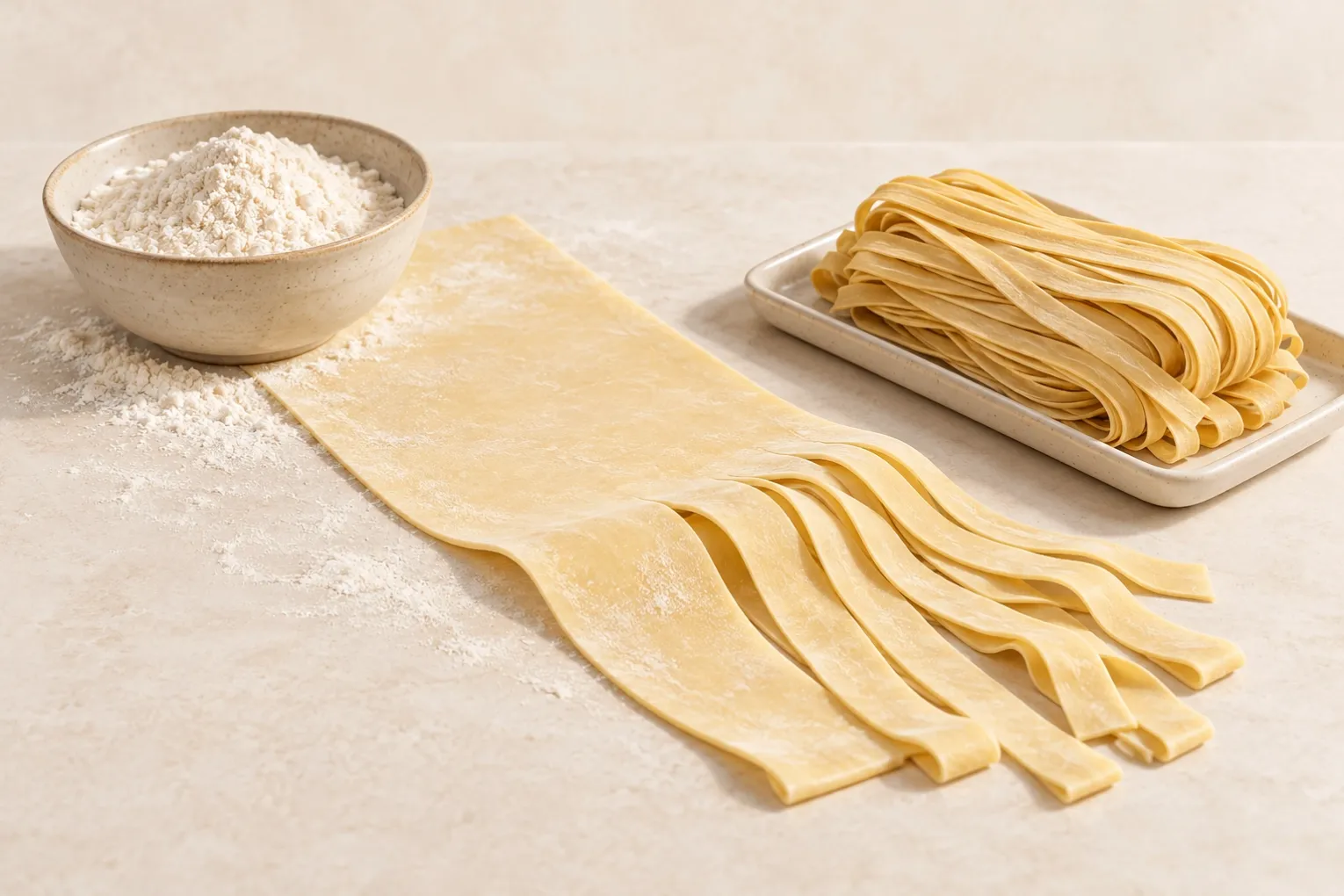
AI-generated conceptual illustration of flour, dough and noodle shapes; not a photograph of Noodle House production.
For a buyer comparing dried wheat noodles, the useful question is what happens to the dough between flour mixing and the finished pack. A common sheeted-noodle route includes mixing, resting, rolling into a sheet, cutting and drying. These steps perform different jobs; a photograph of a noodle machine does not explain all of them.
This guide describes a general processing route documented in noodle research. It is not a tour of Noodle House’s production line or a specification for every product in our catalog.
From flour mixture to a continuous sheet
Mixing combines the flour with water and the ingredients specified for that noodle. Resting is a separate interval in the process. Rolling, or sheeting, then turns the dough into a sheet from which strands can be cut. A study of wheat starch across noodle-making stages examined kneading, resting, sheeting, cutting and drying separately. Its sequence is a useful way to understand the operations, rather than treating “machine-made” as one step.
For procurement, first separate the recipe from the forming method. Adding egg is an ingredient decision. Making a narrower strand is a shape decision. One does not establish the other. Our Egg Noodle reference lists wheat flour, water, egg and salt; a particular flour blend, mixing time or rolling schedule should not be inferred from that ingredient list.
Rolling and cutting answer different shape questions
Rollers reduce the dough sheet to the intended thickness. Cutting divides that sheet into strands. In one published dried-noodle experiment, researchers mixed the dough, made an initial sheet, rested it, rolled it through successive settings, cut it and then dried it under controlled conditions.
That example also shows why “resting comes before rolling” is an oversimplification: a process can contain more than one rolling stage. The paper’s laboratory settings are not our factory settings or a recommended recipe for buyers.
A practical sample brief should therefore describe both strand width and thickness. Ask for the finished dimensions and an acceptable range, instead of assuming that two noodles with the same width will have the same cross-section.
Drying changes the product after shaping
Drying removes water from the shaped noodles. Temperature and surrounding humidity matter to how that happens. The same experiment studied different drying conditions and measured changes in the uncooked noodles’ mechanical properties. It does not establish a universal “best” drying temperature, cooking time or shelf life for commercial noodles.
For the buyer, the important distinction is between a description of the process and the result required from the supplied noodle. A drying description does not by itself tell you whether the product is ready to eat, how it should be cooked, or how long a finished dish will retain the texture you want.
Turn the process explanation into a product choice
Use the process discussion to narrow a sample request:
- Identify the ingredient variant, such as the catalog Egg Noodle or plain Dried Noodle.
- State the strand shape needed for the dish, including width and thickness where these matter.
- Confirm whether the supplied noodle needs cooking, and obtain the instructions for that exact product.
- Evaluate the sample in the intended soup, tossed or stir-fried dish before approving it.
These are selection steps, not a claim that a different factory process automatically produces a better noodle. Nor does a generic process diagram verify a manufacturer’s equipment, capacity or production history.
If you are preparing a shortlist, send the noodle type, intended dish and required pack format. Ask for the current SKU specification and a suitable sample; any special process requirement can then be reviewed for that product.