Oct 1, 2026Buying Guides
Reduced Salt Is Not Low Salt: Reviewing Noodle Claims for Great Britain
A relative salt reduction and a low-salt threshold answer different questions. Check the claim, comparison evidence and applicable food basis before approving wording.
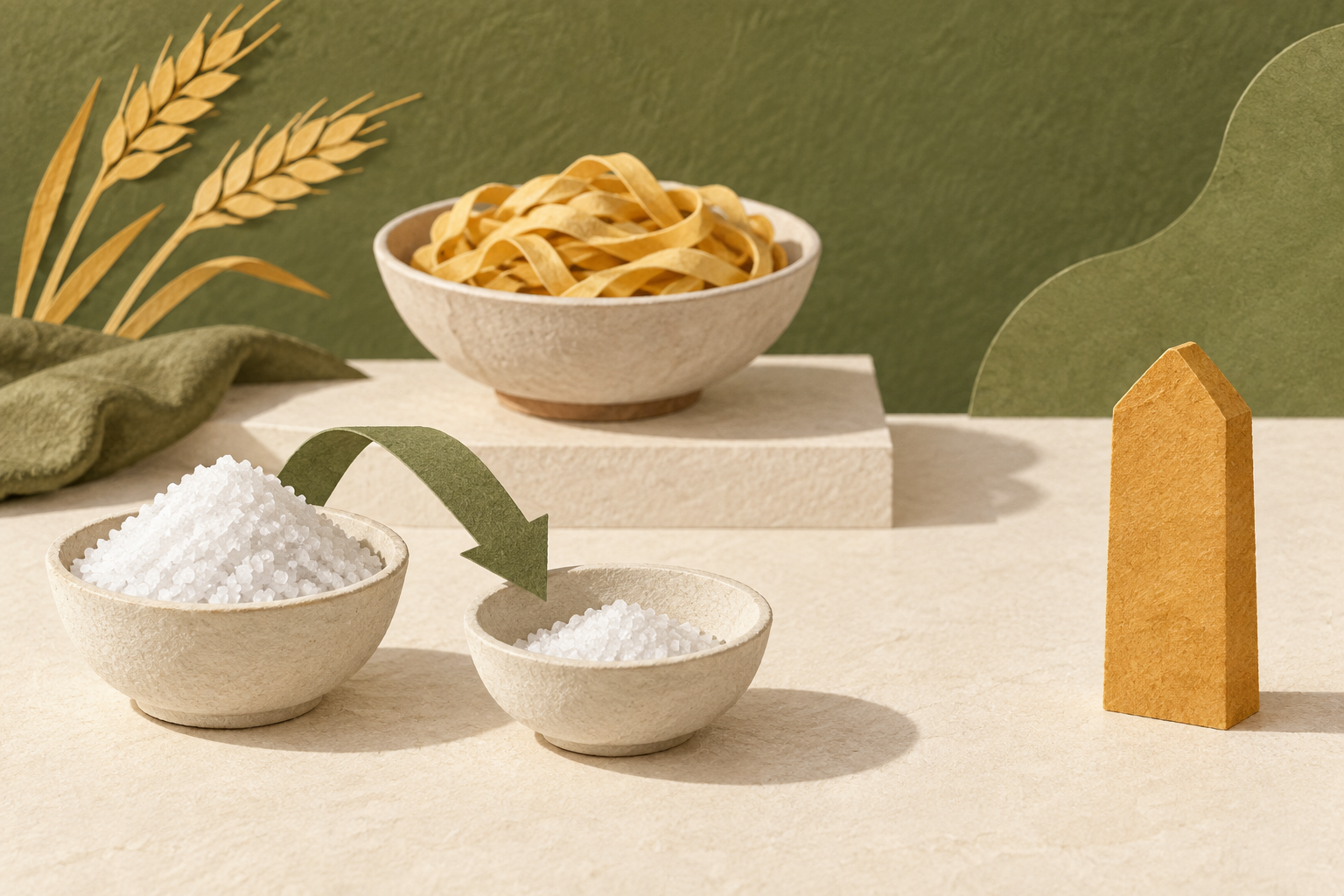
AI-generated editorial illustration of relative reduction and an absolute threshold; not actual nutrient content, a recipe or an approved nutrition claim.
A 25% sodium reduction does not automatically make a noodle product low in salt. “Reduced” compares a product with an appropriate reference; “low” requires meeting an absolute limit.
A buyer commissioning packaging for Great Britain should decide which claim is actually proposed before asking the designer to add a badge. A successful internal reformulation comparison does not approve consumer-facing wording.
Source review: October 1, 2026. Next review: October 31, 2026, or sooner if the register changes. This article concerns England, Scotland and Wales. It does not determine requirements for Northern Ireland or establish any Noodle House product's nutrient values.
Two different numerical questions
The Great Britain nutrition and health claims register, updated May 19, 2026, sets a maximum of 0.12 g sodium, or its salt equivalent, per 100 g or 100 ml for the general low-sodium/salt claim. Its reduced-nutrient entry allows a 25% difference for sodium or salt, rather than the general 30% reduction specified for many other nutrients.
These numerical conditions sit within wider claim requirements. Do not read the percentage alone as permission to print “reduced salt.”
For an internal comparison, label the measured substance explicitly. Sodium and salt are not interchangeable column headings.
A hypothetical reduction that still exceeds the low threshold
Assume two illustrative values are already on the same applicable basis for review: 0.8 g sodium per 100 g for the reference and 0.6 g for the proposed product.
The reduction is:
(0.8 − 0.6) ÷ 0.8 × 100 = 25%.
However, 0.6 g sodium per 100 g is still above 0.12 g. The arithmetic therefore does not support a low-sodium/salt conclusion.
These invented values are not noodle specifications, actual test results or a qualifying market comparison. They demonstrate why the relative calculation cannot answer the absolute-limit question.
The comparator and food basis still need review
The government's claims compliance guidance explains that comparative claims should consider an appropriate range of similar products, including other brands, and the same quantity of food. A single representative standard product may be relevant in some circumstances; choosing an unusually high reference simply to create a large reduction is not a sufficient approach.
The guidance also addresses food ready for consumption according to the manufacturer's instructions. Have the reviewer establish the applicable basis for the product before calculating either condition.
Our as-sold versus as-prepared nutrition guide helps preserve that source context. Do not convert a dry-food figure using an assumed cooking yield merely to reach a desired claim threshold.
Prepare a claim-specific evidence packet
For the proposed pack, put these inputs together:
- Exact wording and artwork location of the intended claim.
- Current product and formulation reference.
- Supporting sodium or salt data, units, food basis and source.
- For a comparative claim, the proposed comparator evidence and calculation.
- Reviewer’s decision on the full claim conditions and accompanying presentation.
These are suggested handoff items, not a substitute for a market-specific label assessment. If the evidence establishes only an internal reduction, keep that outcome separate from approved marketing language.
Keep approved wording tied to the evidence
After review, retain the wording with the relevant data and artwork revision. Avoid replacing an approved comparative phrase with “low salt” during a later design edit; that changes the question the evidence must answer.
For an OEM noodle discussion, send the selected SKU, GB destination and proposed nutrition wording through our contact page. Ask what current product information is available for review. This guide does not claim that a low-salt formulation is offered or that either claim is approved for a Noodle House product.