Sep 30, 2026Buying Guides
Noodle Sensory Tests: Difference Does Not Mean Preference
Separate sensory difference or similarity from consumer liking before commissioning a noodle comparison or interpreting a triangle-test report.
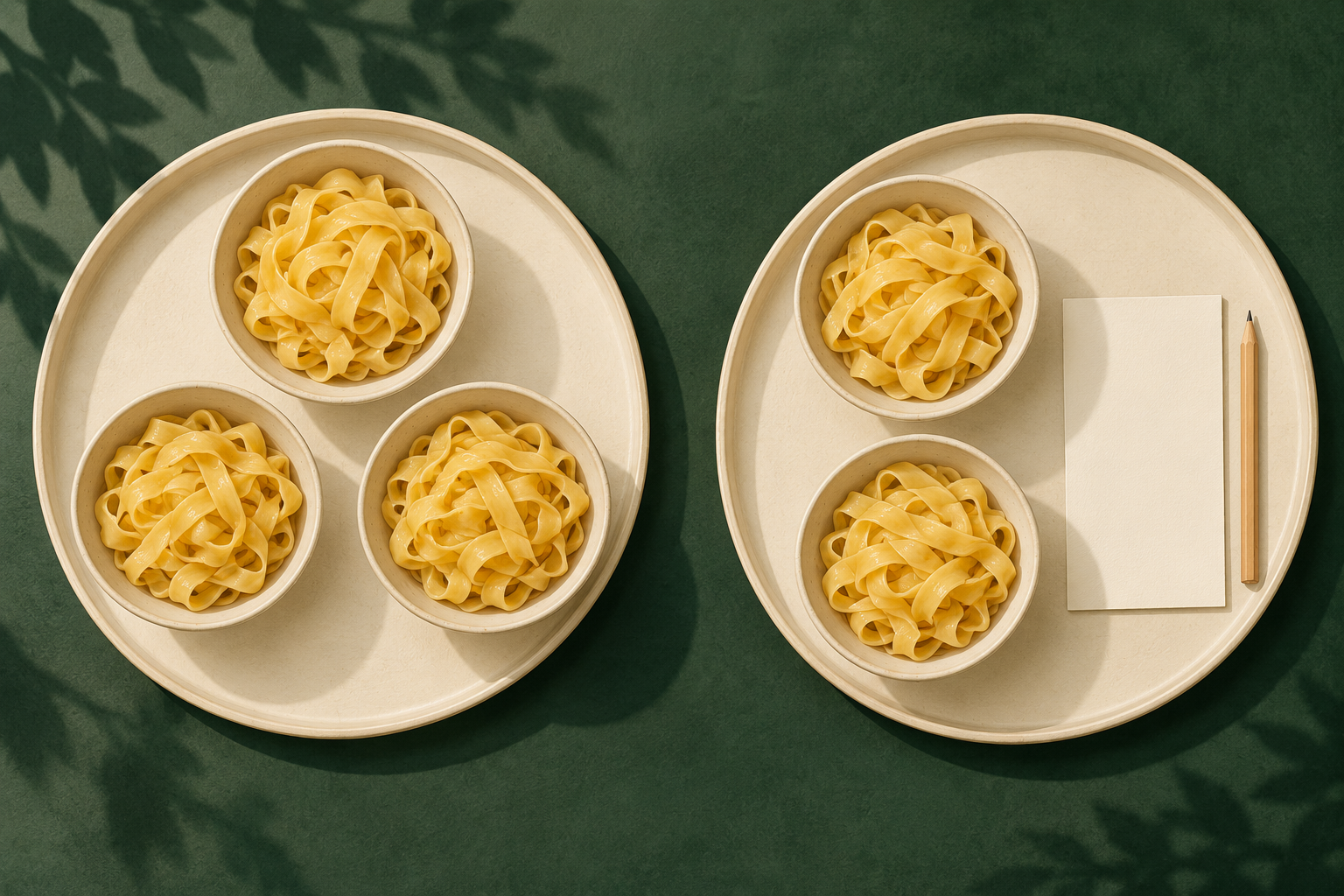
AI-generated editorial illustration of separate sensory research questions; not an actual company test or a testing protocol.
A test showing that two noodle samples are perceptibly different does not tell a buyer which one consumers like more. Before commissioning a comparison, decide whether the commercial question is continuity after a proposed change or preference between alternatives. Those decisions need different evidence.
This distinction matters when a project team receives a report headed “triangle test” and wants to use it as permission to advertise an improved taste. The report may answer a narrower question than the proposed claim.
Start with the decision the result must support
Consider a hypothetical importer reviewing a proposed revision to a dried egg noodle. Purchasing wants to understand whether customers could notice a sensory change. Marketing wants to know whether the revised version is more appealing. The kitchen team wants to know whether it still performs in the intended dish.
Writing all three requests as “please confirm the sample is better” hides their differences. Before samples leave the project team, assign a separate question to each decision:
- Sensory continuity: what evidence is needed about a perceptible difference or similarity?
- Consumer response: which version is preferred by the relevant consumers?
- Application fit: does the version meet the buyer's agreed cooking and handling requirements?
The third question belongs with a controlled application trial. Our noodle sample scorecard can help organize those operational observations. It should not be presented as a substitute for a properly designed sensory study.
Read a triangle-test conclusion within its scope
ISO 4120:2021 describes a method for examining perceptible sensory difference or similarity between two products. Its public abstract says that the method does not identify the size, direction or sensory attribute behind a difference. It also identifies limits involving product homogeneity and strong lingering flavours. The test designer should decide whether it suits the samples. See ISO's triangle-test scope.
A purchasing team should therefore avoid translating “a difference was detected” into “the new noodle has better texture.” The first conclusion does not identify texture as the reason, and “better” introduces a preference judgement that the conclusion has not supplied.
Equally, do not relabel an inconclusive comparison as proof that the products are identical. Ask the study author what the stated conclusion supports under the design actually used. A similarity question should be planned as such, with the intended interpretation agreed before results arrive.
Ask a preference question separately
ISO 11136 addresses consumer hedonic testing: assessing how much consumers like products or relatively like one product compared with another. That scope concerns consumer response, rather than simply detecting a sensory difference. See ISO's guidance on consumer liking tests.
For a buyer, the practical next step is to describe the intended consumers and use occasion to the researcher. A result from one recruited group should retain that group and test context in the purchasing record. Do not turn an internal office tasting into a claim about an entire destination market.
Keep the preparation question visible
A proposed comparison may concern the noodle itself, or the noodle served in a particular sauce or broth. Tell the test designer which decision matters before choosing the presentation. If the intended commercial use includes holding before service, raise that requirement at the planning stage.
This is not a recommendation to invent a triangle-test protocol in the purchasing department. Participant selection, sample numbers, presentation and statistical interpretation need an appropriate design. A buyer brief can be concise without pretending to provide those technical choices.
Include the two identified product versions, the proposed change, the intended dish, the commercial decision and the language the team expects to use after the study. Ask the researcher to flag any question the proposed design cannot answer.
Close the review with a bounded decision
Return to the hypothetical revision. A sensory difference result could lead to further consumer testing, a discussion of the changed attribute or a decision not to proceed. It does not automatically select a winner. Keep the study conclusion, application observations and commercial decision as separate entries, linked to the same sample versions.
For a noodle product or OEM discussion, send the selected product, intended application and the question your evaluation must answer through the contact page. Confirm available samples and information for the project; no particular sensory-testing service or outcome is assumed.