Oct 1, 2026Buying Guides
Does a Low ATP Swab Result Prove Noodle Equipment Is Allergen-Free?
A general cleanliness reading does not establish removal of a particular allergen. Ask what the method detects and how it supports the cleaning programme.
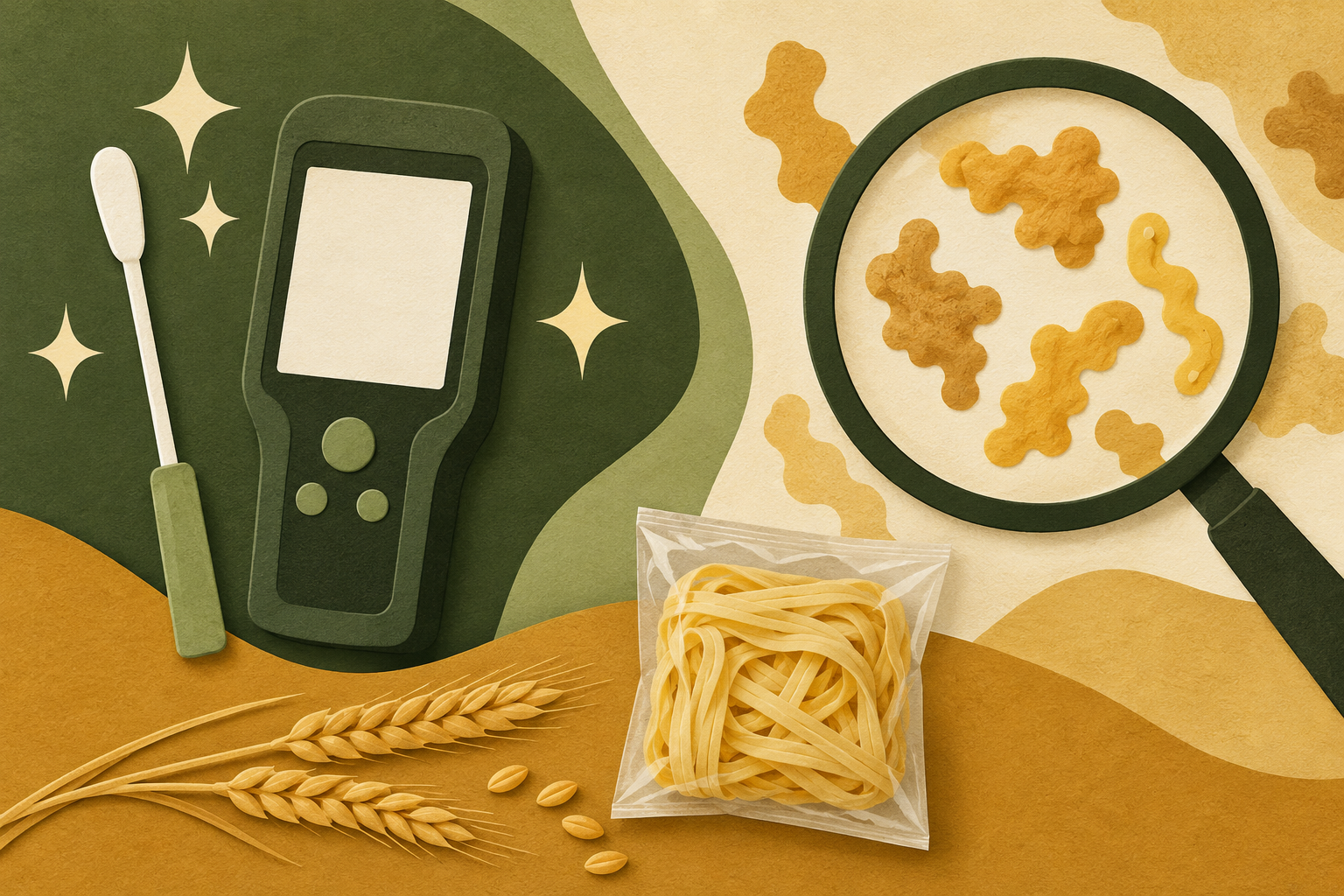
AI editorial illustration: general hygiene checks and allergen-specific evidence answer different questions; this is not a real test result or facility image.
No. A low or negative ATP swab result should not, on its own, be treated as proof that noodle equipment is free from a particular allergen. First establish what the test measures and how that result fits the relevant cleaning evidence.
ATP means adenosine triphosphate. Its use as a general cleanliness indicator is a different question from detecting a specified allergenic protein.
Match the measurement to the claim
A Food Standards Agency review found that visual inspection and ATP testing should not be the only detection methods relied on for allergen cleaning. It identified studies in which surfaces appeared clean or passed ATP testing while allergen residues remained detectable. The review also recognises that a surrogate method may support monitoring where its suitability has been demonstrated during validation. FSA food-allergen cleaning review, detection-method findings.
The practical distinction is not “ATP has no use.” It is that an ATP result and an allergen-specific result cannot automatically be substituted for one another. The relationship needs evidence for the actual application.
Ask what the result was intended to demonstrate
When reviewing a supplier’s cleaning information, ask which allergen or residue is under consideration, which surface or product was sampled and what question the method was chosen to answer. “Pass” without that context is incomplete.
A purchasing colleague does not need to design the laboratory method. The useful role is to identify whether the evidence supplied answers the requested question, then refer technical decisions to the competent food-safety personnel.
For example, a general hygiene log may support monitoring of a defined cleaning programme. It should not be relabelled as a certificate that every subsequent noodle product contains no allergen residues.
Keep the scope of the evidence visible
A proposed supplier-evidence request can ask for:
- The cleaning scenario and relevant products or residues.
- The method used and what it is capable of detecting.
- The sampled locations or material and sampling time.
- The basis for the acceptance criterion.
- The explanation of how monitoring relates to the validated cleaning approach.
These are questions for the responsible technical team, not a universal test protocol. Do not copy an ATP threshold from another instrument or factory into a purchase specification. Do not invent a testing frequency or assume a single swab represents the whole production process.
Resolve a hypothetical audit misunderstanding
Imagine a buyer requests evidence about removal of an unintended allergen after a product changeover. The reply contains a clean-looking photograph and a low ATP reading, but no explanation linking that method to the allergen-control question.
The appropriate next step is to ask the technical team for the relevant evidence and its limitations. It is not to declare the equipment unsafe from the missing information, nor to approve an allergen-free statement from the reassuring number.
This scenario is hypothetical. It does not describe Noodle House Food’s equipment, cleaning programme, test results or product allergen status.
Keep technical and label decisions separate
A cleaning evidence review supports risk assessment; it does not automatically approve a consumer label claim. Ingredient declarations, precautionary statements and any free-from claim require the relevant product and market review.
Use the product-document guide to organise an evidence request. For a selected noodle SKU, send the destination and specific document question through the contact page. Confirm what can be supplied for that product and order without assuming unverified certifications or testing services.
Reviewed: 1 October 2026. The FSA source is a research review, not a product approval or a prescribed cleaning procedure.