Sep 16, 2026Buying Guides
How to Shortlist Noodle SKUs from a Chinese Manufacturer’s Catalog
A buyer’s method for choosing dried noodles, egg noodles, vermicelli and snacks by market, channel, pack, MOQ and product role.
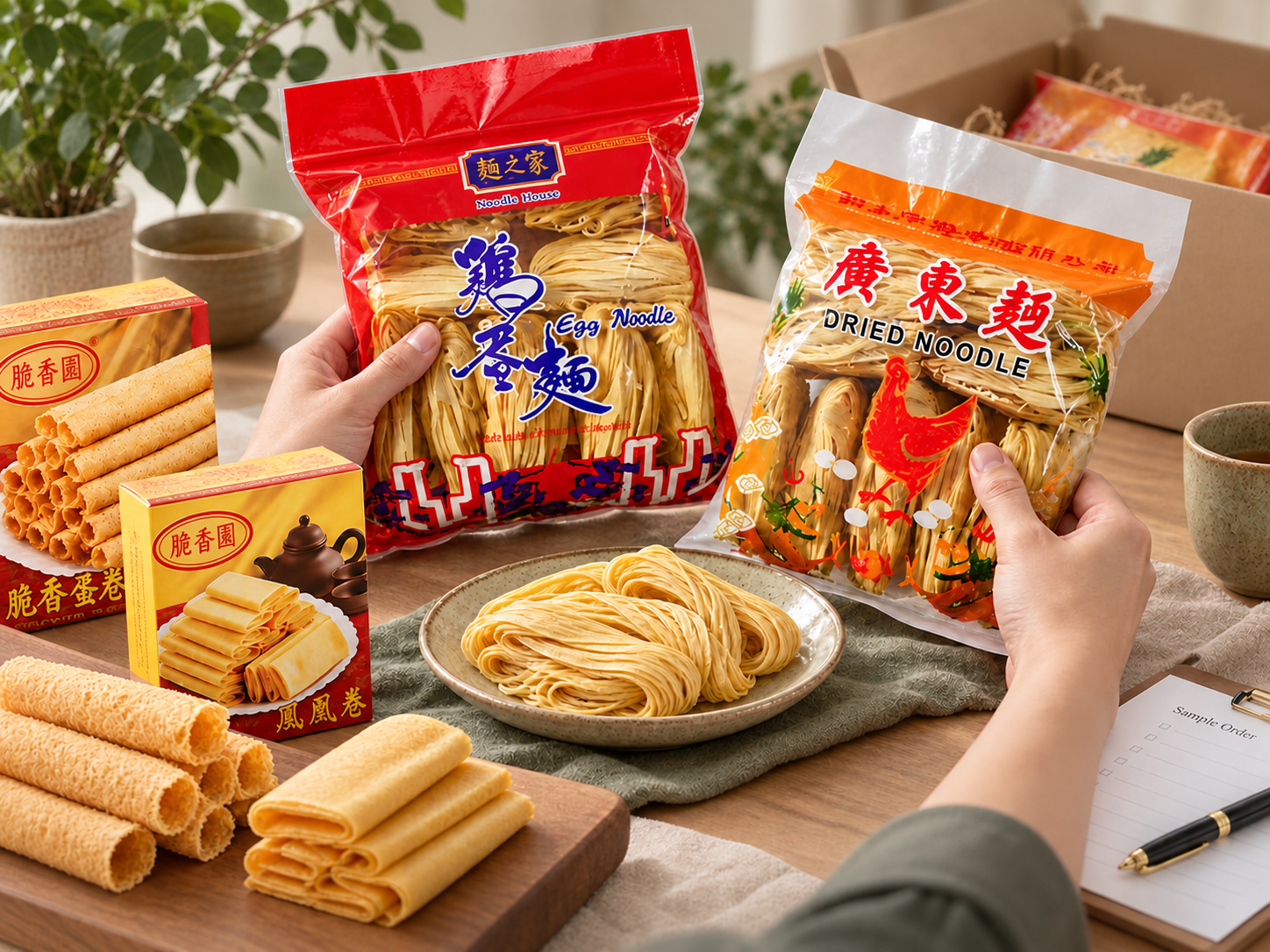
A large product catalog can make a sourcing project feel productive, but requesting prices and samples for every SKU usually slows the decision. The buyer receives too much information, the supplier cannot see the real market priority and the sample set becomes difficult to evaluate consistently.
A better approach is to turn the catalog into a focused shortlist. For a first review, three to five products can be enough to test category fit, product quality, packaging and commercial terms.
This guide shows importers, distributors, Asian supermarkets and foodservice buyers how to shortlist noodle SKUs from a Chinese manufacturer’s catalog.
- Begin with the Customer and Channel
The same noodle range should not be selected in the same way for every buyer.
Importer or distributor
An importer may need a balanced range that can support several customers. Important factors include recognizable categories, shelf stability, carton efficiency, MOQ, document availability and repeat supply.
Asian supermarket
A supermarket buyer may focus on retail pack size, shelf presentation, familiar cooking uses, label space, barcode requirements and enough assortment variety without duplicating similar products.
Foodservice distributor
A foodservice buyer may prioritize cooking consistency, usable pack size, yield, breakage, menu applications, warehouse handling and repeat-order reliability.
Private-label brand
A private-label team should first choose the noodle base and target customer, then evaluate packaging structure, artwork, label requirements and commercial minimums.
Write the primary channel at the top of the shortlist. If one order serves several channels, score each SKU separately for each channel.
- Define the Product’s Role in the Assortment
Each shortlisted item should have a job. A practical first assortment can use three roles.
Core product
A familiar, repeat-use product that can support regular demand. Examples may include a plain dried wheat noodle or egg noodle.
Differentiated product
A product that gives the assortment a reason to be noticed, such as a seafood-flavored noodle, a specific regional-style noodle or a distinctive traditional snack.
Test product
A product with potential but less certain demand. The buyer tests it in a limited quantity and reviews sell-through or customer feedback before expanding.
This structure is more useful than choosing several products that all solve the same need. A catalog of five very similar noodles may look broad but give the distributor little category coverage.
- Map the Current Product Categories
Noodle House Food’s current public range includes shelf-stable Chinese dried noodles, egg noodles, flavored wheat noodles, Amoy flour vermicelli and traditional snacks.
Examples currently shown on the product catalog include:
• Dried Noodle;
• Egg Noodle;
• Shanghai Noodle;
• Shrimp Noodle;
• Scallops Noodle;
• Fried Noodle;
• Cream Noodle;
• Fine and White Plain Noodle;
• Amoy Flour Vermicelli;
• egg rolls, phoenix rolls, biscuit rolls and Shagima products.
Treat the public catalog as a selection tool, not the final technical specification. Ask for current pack, carton, shelf-life and document information for the exact SKU before quotation.
- Filter by Product Fit Before Looking at Price
Create a “must have” filter. A SKU that fails a required market or channel condition should not move forward simply because it has an attractive price.
Possible must-have criteria include:
• correct product category and raw material;
• required flavor profile;
• shelf-stable format;
• target retail or foodservice pack;
• suitable cooking application;
• label language and artwork feasibility;
• required document support;
• acceptable MOQ;
• target shelf-life requirement;
• acceptable allergen profile.
Mark each criterion as:
• required;
• preferred;
• flexible;
• not relevant.
This allows the supplier to recommend an existing SKU when the buyer is flexible, while protecting the non-negotiable market requirements.
- Compare Known Pack and Carton References
Public product pages can help buyers understand how different SKUs are positioned.
At the time of this review:
• Shrimp Noodle is publicly listed in a 454g bag with 30 bags per carton;
• Amoy Flour Vermicelli is publicly listed in a 300g box with 40 boxes per carton;
• Shanghai Noodle is publicly listed with 340g and 227g bag options, with carton packing to be confirmed;
• Dried Noodle and Egg Noodle pages ask buyers to confirm the exact pack and carton specification by SKU.
These references should be reconfirmed before ordering. They illustrate why a shortlist cannot use product names alone. Unit size, carton count and retail format affect price comparison, shelf placement, freight and trial-order planning.
- Avoid Choosing Too Many Similar SKUs
Compare shortlisted products for overlap.
Ask:
• Do two products have the same target customer and application?
• Is the flavor difference meaningful to the market?
• Will the retailer give both products shelf space?
• Can the distributor explain the difference to customers?
• Would one stronger core SKU perform better than three weak variations?
If two items have the same role, keep the stronger candidate and move the other to a future-testing list. The goal is not to reproduce the supplier’s entire catalog in the first order.
- Build a Three-to-Five-SKU First Shortlist
A balanced example for an Asian-grocery distributor might include:
- Core: Egg Noodle for a familiar retail and foodservice category.
- Core: Dried Noodle or Shanghai Noodle for broad cooking use.
- Differentiated: Shrimp Noodle or another flavored noodle.
- Category extension: Amoy Flour Vermicelli for a thinner wheat-noodle format.
- Optional test: A traditional snack if the buyer wants a mixed noodle-and-snack program.
This is a framework, not a fixed recommendation. The final list should reflect the buyer’s actual customers, price architecture, local competition and import requirements.
For a foodservice buyer, the shortlist may be narrower and focus on cooking consistency. For a private-label brand, it may begin with one noodle base and one packaging concept.
- Score the Shortlist Before Requesting Samples
Use a simple 1–5 score for each factor:
Factor | What to Evaluate
Market fit | Does the target customer already buy or understand the product?
Channel fit | Is the pack and application suitable for retail or foodservice?
Differentiation | Does the SKU add a clear role to the assortment?
Specification readiness | Are unit, carton, shelf life and ingredients available for review?
Document readiness | Can required product and market documents be checked?
MOQ fit | Can the buyer test the SKU without excessive inventory risk?
Margin potential | Does the normalized landed-cost scenario fit the target price?
Repeat potential | Could the product support regular reordering?
Do not let a high score in one area hide a critical failure. A product with strong differentiation but no confirmed route for required market documentation should remain on hold.
- Request a Focused Sample Set
After scoring, request samples for the strongest two to four products.
Tell the manufacturer:
• selected product names or screenshots;
• target market and channel;
• intended dish or customer use;
• estimated quantity by SKU;
• existing packaging or private-label direction;
• important ingredient, allergen or document requirements;
• what the team will evaluate.
Test samples using the same cooking and scoring method. Record cooking time, texture, flavor, breakage, portion suitability, packaging and customer feedback.
Sample charges, courier charges, customs information and delivery arrangements should be confirmed before shipment. Do not assume that every sample or international shipment is free.
- Request Commercial Details Only for the Finalists
Once the sample and specification review identifies the finalists, request:
• current unit and carton packing;
• carton dimensions and gross weight;
• MOQ per SKU;
• mixed-SKU conditions;
• typical lead time after order details are confirmed;
• document availability;
• current quotation and validity;
• trade term and destination basis;
• private-label scope, if required.
Noodle House Food’s public information lists a normal wholesale discussion from 100 cartons and a typical production lead time of 15–20 days after details are confirmed. Both remain subject to the selected SKU, packaging and order arrangement.
Copy-and-Paste Catalog Shortlist Worksheet
Buyer country:
Target market:
Primary channel:
Target customer:
SKU 1:
Role: Core / Differentiated / Test
Target application:
Preferred pack:
Estimated quantity:
Required documents:
Why shortlisted:
SKU 2:
Role: Core / Differentiated / Test
Target application:
Preferred pack:
Estimated quantity:
Required documents:
Why shortlisted:
SKU 3:
Role: Core / Differentiated / Test
Target application:
Preferred pack:
Estimated quantity:
Required documents:
Why shortlisted:
Flexible items:
Non-negotiable requirements:
Sample evaluation date:
Decision owner:
Common Catalog-Shortlisting Mistakes
• asking for samples of the entire catalog;
• choosing several nearly identical products without clear assortment roles;
• selecting by flavor or appearance before checking market and channel fit;
• assuming public pack information is the final commercial specification;
• ignoring carton size, MOQ and warehouse impact;
• requesting private-label artwork before approving the noodle base;
• treating all certificate claims as applicable to every SKU;
• failing to record why each product was selected or rejected.
FAQ
How many noodle SKUs should a new importer shortlist?
Three to five products are often enough for the first specification and commercial review. A focused sample set may be smaller.
Should the first order include only best-selling products?
Not necessarily. The buyer needs a balance of market familiarity, differentiation and channel fit. Local customer evidence is more useful than a generic “best seller” label.
Can noodles and traditional snacks be combined in one shortlist?
They can be considered as a mixed category program, subject to product availability, MOQ, carton planning and buyer demand. Keep the category roles clear.
When should private-label packaging be discussed?
Define the brand and packaging direction early, but approve the noodle base and basic commercial feasibility before investing heavily in final artwork.
Request a Focused Product Catalog
Open the current noodle and snack catalog, select three to five relevant products, then send the shortlist with your target market, channel, quantity and packaging needs. Noodle House Food can then check the current pack, carton specifications, MOQ and available document support for the selected SKUs.