Sep 30, 2026Buying Guides
Container Condensation: Checks Before Loading Noodle Cartons
A dry-looking container is not a complete moisture-control plan. Review packing conditions, materials and the proposed protection before loading dried noodle cartons.
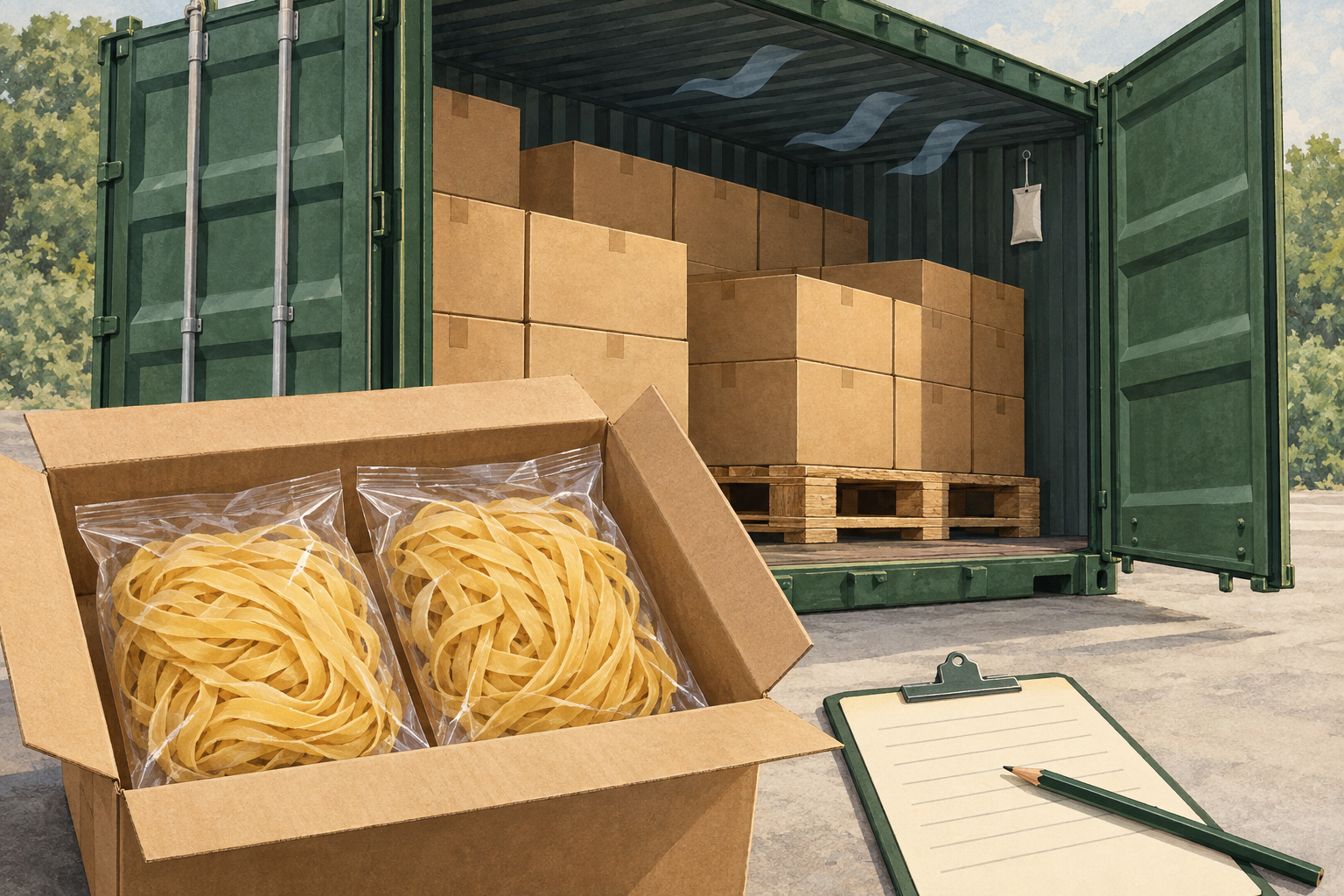
AI-generated editorial illustration of a container moisture-control review; not an actual shipment, packing instruction or verified desiccant arrangement.
Before loading dried-noodle cartons, ask how moisture could enter the closed container and how the proposed packing plan addresses it. A photograph of an empty, dry-looking floor records one observation; it does not explain the condition of the cartons, pallets or bracing that will be loaded afterwards.
The useful buying decision is whether the parties have enough information to accept the proposed moisture-control arrangement, or whether loading needs further review. This article offers questions for that decision, not a universal desiccant dosage or a cargo-securing design.
Why the container itself is only part of the question
Annex 3 of the IMO/ILO/UNECE CTU Code identifies cargo, timber, pallets, porous packaging and wet or humid packing conditions as potential sources of internal moisture. When cooling brings air into contact with sufficiently cold surfaces, water can condense; droplets from the inner roof can then wet the load.
For a noodle order, that means the review should include the materials travelling with the food. It should not stop at the retail bag or at the freight container's apparent condition before packing. The Code is general transport guidance, not evidence of conditions in a particular shipment.
Follow the load from storage to door closure
Ask the packing party to describe the actual route taken by the cartons and packing materials on loading day. The following three moments are useful points for discussion.
Before the materials reach the loading area: Identify where cartons, pallets and bracing have been stored and how their condition will be checked. Request the method and criteria used by the responsible party; do not substitute a generic internet moisture number for a material-specific assessment.
While the load is exposed: Ask what happens if rain reaches the loading area or work is interrupted. A plan should explain who decides whether exposed materials require review and how the decision is recorded. A forecast alone does not show what happened during the operation.
Before the doors close: Confirm that the proposed protective measures match the actual materials and route. Record unresolved differences between the agreed plan and the load presented for dispatch. If the load changes, ask whether the protection needs reassessment.
These are suggested review points. They do not claim that every order needs the same equipment, procedure or numerical acceptance threshold.
Ask what a proposed desiccant arrangement is designed to handle
“We will add drying bags” is an incomplete answer. Ask the party proposing them to explain the expected moisture sources, the basis for the selected capacity, the arrangement and the relevant use limitations.
CTU Code Annex 3 warns that desiccants generally lack enough capacity to compensate for hygroscopic cargo that is not sufficiently dry for transport. That is a reason to examine the moisture sources before relying on an accessory. It is not a calculation of how many bags a noodle shipment needs.
For food cargo, also ask how the chosen arrangement avoids damage to packs and unwanted contact or leakage. Obtain the proposed product's instructions and have the responsible packing or quality specialist assess its suitability. Do not infer suitability solely from a supplier's promotional photograph.
A booking deadline should not close an unanswered question
Consider a hypothetical situation: the carton and container photographs are ready, but the pallet storage condition has not been confirmed. The desiccant proposal also has no stated basis.
The next action is to ask the packing party to close those two questions before accepting the arrangement. Adding more drying bags would not establish the missing pallet condition. Equally, an incomplete record does not prove that the actual pallets are wet. Keep the observation and the unanswered question separate.
If the parties choose a revised arrangement, record what changed and who accepted it. Preserve the original proposal so that the reason for the revision remains understandable.
Retain a record that explains the decision
A compact dispatch file can identify the container, loading date, parties responsible for packing and review, material-condition evidence, proposed protection and resolution of exceptions. Link photographs to their location and stage of loading rather than saving an unlabeled folder of images.
At receipt, record any wet or damaged packaging under the agreed quality procedure. An arrival photograph alone does not establish whether the cause was condensation, water entry or an earlier exposure, nor does it determine responsibility. Preserve the evidence and request an investigation before drawing those conclusions.
For the separate handling decision, see palletized versus floor-loaded noodle cartons. For arrival records, use the warehouse receiving checklist.
Preparing a wholesale noodle shipment? Send the SKU list, destination and proposed shipping arrangement, then agree the packing and moisture-control responsibilities with the supplier, forwarder and receiver for that order.
Technical reference: CTU Code, January 2014, Annex 3. Checked 30 September 2026. The questions above are practical recommendations; they do not certify a shipment or replace a competent packing assessment.