Oct 8, 2026Buying Guides
Dried Noodle Samples: Cloudy Cooking Water Is Not a Cooking-Loss Result
Cloudy cooking water, cooked noodle weight and cooking loss answer different questions. Check the method and dry-matter basis before comparing dried noodle samples.
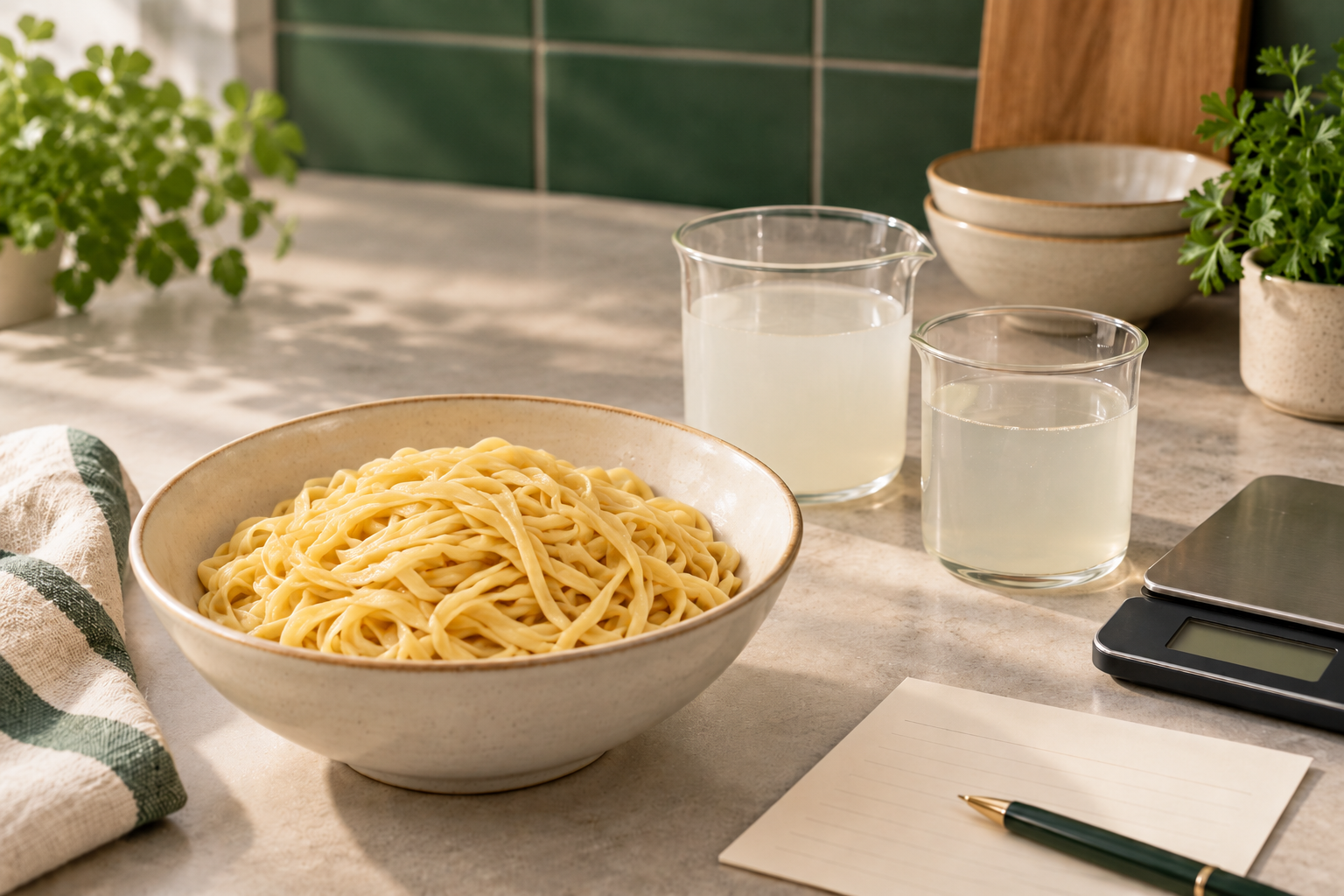
AI-generated editorial illustration of a noodle sample review; not a product photograph or a record of measured test results.
A cloudy pot is a useful observation when choosing dried noodles for a soup menu. It is not, by itself, a measurement of how much noodle material was lost during cooking. Keep those two questions separate: Does the prepared dish look right? And what does a measured cooking-loss result actually represent?
For buyers comparing Noodle House Food's Egg Noodle with another identified wheat-noodle sample, this distinction prevents a visual impression from becoming an unsupported product ranking. No comparative cooking-loss results for the company's SKUs are presented here.
Three observations that answer different questions
Appearance of cooking water or finished soup
What it can help assess: Whether the appearance meets the buyer's menu requirement under the recorded preparation method
What it does not establish: A percentage of noodle solids lost
Drained cooked-noodle weight
What it can help assess: Output under the stated cooking and draining procedure
What it does not establish: How much original dry matter remains
Cooking-loss test result
What it can help assess: Loss of noodle material under the laboratory's stated method and calculation basis
What it does not establish: Overall eating quality or suitability for every dish
Absorbed water and retained noodle material are different quantities. A heavier cooked sample is not evidence that it lost fewer solids. Research on wheat noodles measures water uptake and mass loss separately; the specific laboratory noodles and conditions in that work cannot establish the performance of a Noodle House product. Roppongi, Ogawa and Adachi, 2014
What a research method adds to the comparison
In a study of three dried wheat-noodle types, Cai and colleagues determined cooking loss using the initial dry matter and the dry mass remaining after cooking. They measured soup turbidity separately, using an optical reading at 720 nm after standardizing the liquid volume. The two measurements therefore came from different procedures; a photograph of cloudy water does not supply the weighing data needed for that cooking-loss calculation. Cai et al., Foods 12(1), 55, methods section 2.3
This is a methodological reference, not a universal acceptance limit. The study did not test Noodle House Food's Egg Noodle or Shanghai Noodle. Its product rankings and numerical results should not be transferred to those SKUs.
Read the denominator before comparing percentages
Ask whether a reported percentage uses the original sample weight or its moisture-corrected dry matter. A percentage without that definition is incomplete.
Illustrative arithmetic only — not a product test: suppose an uncooked sample weighs 100 g, contains 12 g of moisture, and loses 4 g of dry matter in a defined test. The initial dry matter is 88 g. The loss is 4.00% of the original sample weight, but approximately 4.55% of its initial dry matter. The physical loss has not changed; the denominator has.
Do not rank two supplier reports until their methods, moisture basis, sample preparation and cooking endpoints are compatible. A lower printed percentage can be misleading when the calculation basis differs.
Apply the distinction to a noodle shortlist
Start with the exact product identity. The current Egg Noodle product page lists a 454 g pack and wheat flour, water, egg and salt as its catalog ingredient reference. Those details identify the sample to request; they do not predict its cooking loss. Obtain the current specification and preparation instructions for the actual sample supplied.
For a soup application, separate two decisions:
- Menu decision: prepare the coded sample in the intended process and assess the final bowl. Record whether noodles are cooked directly in the serving broth or cooked separately and transferred. The liquid being evaluated must be identified.
- Technical comparison: if solids loss matters to the purchase specification, request comparable measured results or agree a laboratory method before setting a numerical criterion.
A buyer may reject a sample because its finished soup appearance does not meet the menu brief. Record that reason as an appearance result. Do not relabel it as a measured cooking-loss failure.
Use the existing noodle cooking-test checklist for preparation controls. The additional requirement here is to keep the visual observation, cooked weight and laboratory loss result in separate fields.
A short request to send with the sample codes
“For each identified noodle sample, please provide any available cooking-loss result together with the method, uncooked sample weight, cooking endpoint, moisture basis and calculation. Please identify whether the value comes from dry residue in the cooking liquid or dry matter retained in the cooked noodles. If no result is available, mark it as unavailable.”
This is a suggested buyer request, not a claim that the company offers a particular laboratory service. Mark missing results as unavailable; do not enter a value estimated from soup colour, pack weight or another noodle's report.
To discuss suitable samples, send the product names and intended soup preparation process. Include the appearance requirement and any existing test specification so the sample discussion addresses the actual menu choice.