Sep 30, 2026Buying Guides
Reading a Noodle Packaging Barcode Verification Report
Read grade, aperture and wavelength together before comparing verification reports for a proposed noodle pack.
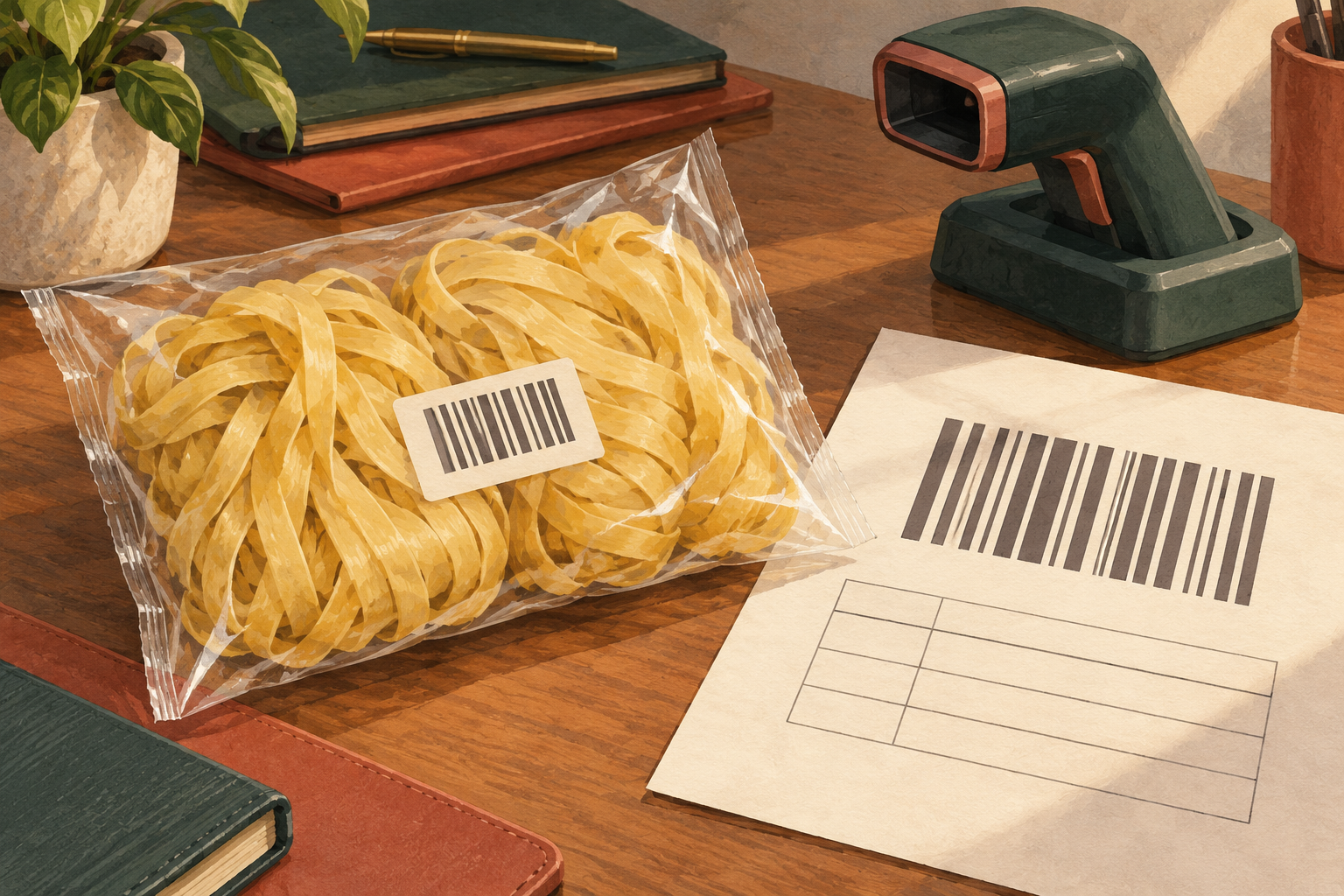
AI-generated editorial illustration of a noodle-pack barcode review; the barcode, report sheet and equipment are conceptual, not an actual verification result or approved packaging.
When a printing provider sends a barcode grade for a proposed noodle pouch, ask for the measurement conditions alongside the number. Two grades cannot support a fair packaging comparison if the reports use different settings or refer to different versions of the sample.
This guide helps an importer read a linear, or 1D, barcode report before asking a specialist to accept the result. It does not set a universal pass grade or extend a result to an entire production run.
Read all three parts of the grade notation
The GS1 General Specifications, Release 26.0, section 5.12.2, express the quality specification using grade/aperture/wavelength. The 1D verification guideline, section 4.5.1.1, explains that reporting notation. The aperture describes the measuring area; the wavelength describes the light used for the measurement. They are test conditions, not product dimensions.
For a purely illustrative report entry of 2.8/06/660:
- 2.8 is the overall symbol grade on the four-point scale.
- 06 identifies an aperture of approximately 0.006 inch. It does not mean a six-millimetre-wide bar.
- 660 identifies the light wavelength in nanometres. It is not a printing-resolution setting.
These example values explain the notation only. They are not a required setting, an acceptance threshold or a result for any Noodle House product. Retain the full entry when forwarding a report; copying only “2.8” removes information needed to interpret it.
Establish which requirement the report was assessed against
Ask the reviewer to identify the barcode type, intended scanning environment and applicable requirement. The GS1 quality guidance explains that minimum quality standards vary by application and are set out in the General Specifications' symbol tables.
For a retail wheat-noodle bag and an outer distribution carton, do not assume that an identical acceptance rule applies. Have the responsible barcode specialist confirm the current table and any additional trading-partner instructions. Record the version and scope of that instruction beside the measured result.
This leaves two separate entries in the buyer's record: what was measured and what requirement was used to judge it. A large PASS badge without the underlying basis does not answer both questions.
Compare reports before comparing suppliers
Axicon's linear-verification explanation describes aperture selection in relation to the printed bars. The measurement setup therefore belongs in the comparison, alongside the grade. Use the following comparison before treating a higher grade as evidence of a better printing proposal.
Compare | Record for report A and report B | Buyer decision |
|---|---|---|
Physical subject | Product/pack reference and sample revision | Are both results about the version under discussion? |
Method | Barcode type and cited assessment method | Are the reports assessing the same kind of symbol? |
Measurement | Complete grade notation and stated settings | Are the conditions comparable and appropriate? |
Acceptance basis | Applicable requirement and any buyer instruction | Does the same decision rule apply? |
Report scope | Tested samples and the report's stated limitations | How much of the proposed supply does the evidence actually describe? |
This is a suggested comparison tool, not a mandated test plan. Where an entry differs or is missing, request an explanation before ranking the two numbers. Do not select a more favorable aperture merely to make a result look better.
Resolve a grade disagreement without guessing the cause
Imagine two reports for a proposed egg-noodle pouch: one summary quotes 3.0/10/660, while the other quotes 2.4/06/660. These are invented examples, not actual test data. The aperture references differ, so the figures alone do not demonstrate that print quality improved or deteriorated.
Send both complete reports to the reviewer. Ask which conditions apply to the intended use, whether both reports concern equivalent samples, and what further measurement is needed for a valid comparison. Keep the question focused on comparability rather than asking the printer to “make the score higher.”
If a report identifies a weak parameter, preserve its exact name and value in the follow-up. Ask the specialist to explain the finding and proposed corrective check. A purchasing team should not diagnose a production fault from an overall grade alone.
Keep the conclusion within the evidence
Record the reviewer's decision, the report references it relies on and any unresolved limitation. Handling an incomplete report is different from approving artwork; use the artwork approval workflow for the later release decision.
For an OEM noodle packaging discussion, send the selected SKU, pack revision and destination, together with the precise report question. Confirm which party will arrange any specialist assessment. This article does not imply an in-house barcode verification service.
Sources checked: 30 September 2026. Sources include GS1 General Specifications Release 26.0 (January 2026) and the 1D explanatory guideline (July 2015). Confirm application requirements for the actual barcode before approval.