Sep 30, 2026Buying Guides
Does an ECT Rating Prove a Noodle Carton Can Be Stacked?
An edge-crush result describes a board specimen. Ask for evidence appropriate to the assembled carton and intended load before accepting a stacking promise.
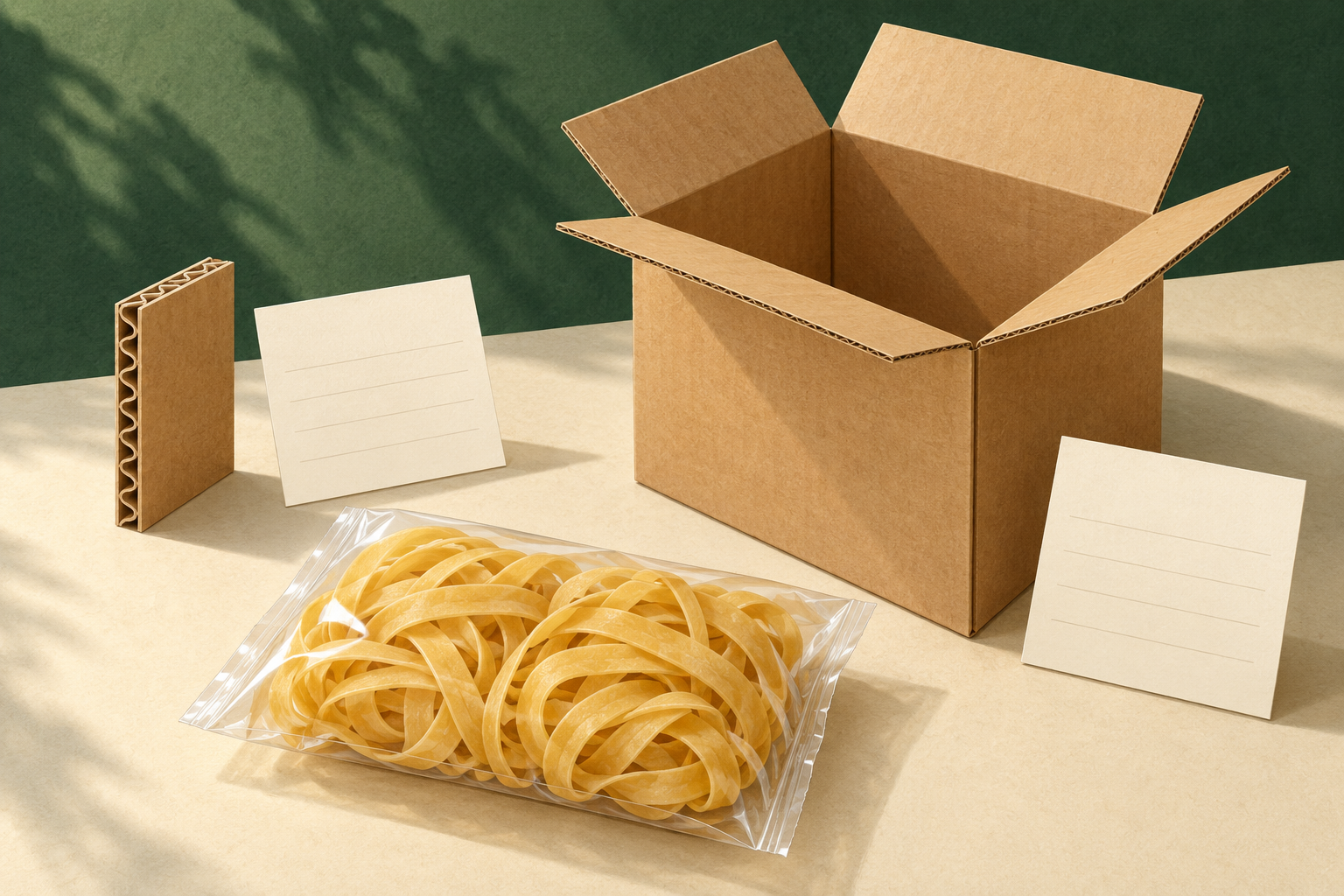
AI-generated editorial illustration of board and finished-carton test scopes; not an actual company test or stacking specification.
An edge-crush test, or ECT, result is not by itself proof that a finished noodle carton can support a specified stack. It characterizes a corrugated-board specimen under a defined test. To assess the assembled carton or a proposed storage arrangement, ask the packaging specialist which evidence addresses that different question.
A buyer should therefore separate three things: the board specification, the finished-box test result and the proposed handling or stacking conditions. A strong-looking material figure does not automatically complete all three decisions.
Confirm what was actually tested
FEFCO lists edgewise crush resistance among corrugated-board tests and compression resistance among corrugated-packaging tests. Its published methods describe an edge-loaded board specimen for the former and compression of an assembled empty container for Method 50. FEFCO test directory · Published testing methods
That distinction changes how a buyer should read a report. Is it about the material used to make the box, a complete box, or a loaded package evaluated under another method? Do not convert one description into another in a quotation summary.
The published FEFCO compilation contains older method editions. Use it here to understand test scope; ask the laboratory or packaging provider to identify the applicable method and edition for the actual project.
A different carton design needs an applicability answer
Imagine two proposed noodle cartons using board described with the same ECT rating. One carton has different dimensions or an altered construction from the other. The shared material description does not establish that the two assembled boxes have identical compression performance.
Ask the provider which design a finished-box result covers. If a report exists for the earlier design, request an explanation of whether and how it supports the new one. Do not replace that question with a photograph showing that the new carton looks tidy.
The master-carton specification guide helps establish the current arrangement and revision. Once that identity is clear, the strength evidence must be connected to it.
Keep the condition of the test specimen visible
For a box-compression report, record whether the specimen was empty or filled, whether inserts were present, how it was assembled and the direction of loading. Retain the conditioning and test environment along with the result.
FEFCO Method 50 calls for a report identifying the packaging, dimensions, construction, test conditions and deviations. Those details help establish what the result actually describes. They do not establish a universal safe stack height. FEFCO published testing methods, Method 50
If one supplier provides an empty-box result and another provides a test involving a filled package, mark that scope difference before comparing the figures. A difference in reported strength may not represent the difference the buyer thinks it does.
Do not turn a peak test force into a warehouse promise
A compression result obtained under specified laboratory conditions is one piece of evidence. Do not divide a peak force by the weight of a noodle carton and announce a maximum number of warehouse layers from that arithmetic alone.
Instead, describe the proposed arrangement to the responsible packaging specialist: filled-carton gross weight, orientation, pallet layout, any overhang, intended storage duration and relevant distribution conditions. Ask what assessment or further evaluation is appropriate and what limits the provider can support for that arrangement.
This is a proposed purchasing review, not a stack-design formula. It deliberately supplies no layer count, safety factor or minimum ECT value because none has been established for a particular Noodle House carton here.
Match the conclusion to the purchasing question
A review can conclude that a board specification is confirmed while the stacking proposal remains unresolved. Keep both statements rather than presenting the first as a general approval of the second.
Likewise, carton compression does not measure every form of product damage. For crisp snacks, the separate egg-roll breakage guide explains how to define and count product damage during an agreed evaluation.
For a wholesale noodle order, share the SKU, current carton reference and proposed warehouse or pallet arrangement through the contact page. Ask which packaging details and supporting evidence can be confirmed before relying on a stacking assumption.