Oct 1, 2026Buying Guides
Testing Noodles for a High-Altitude Kitchen: Why More Heat Is Not the Answer
Higher elevation changes boiling conditions. Record the local process before rejecting a noodle sample or copying a sea-level cooking time.
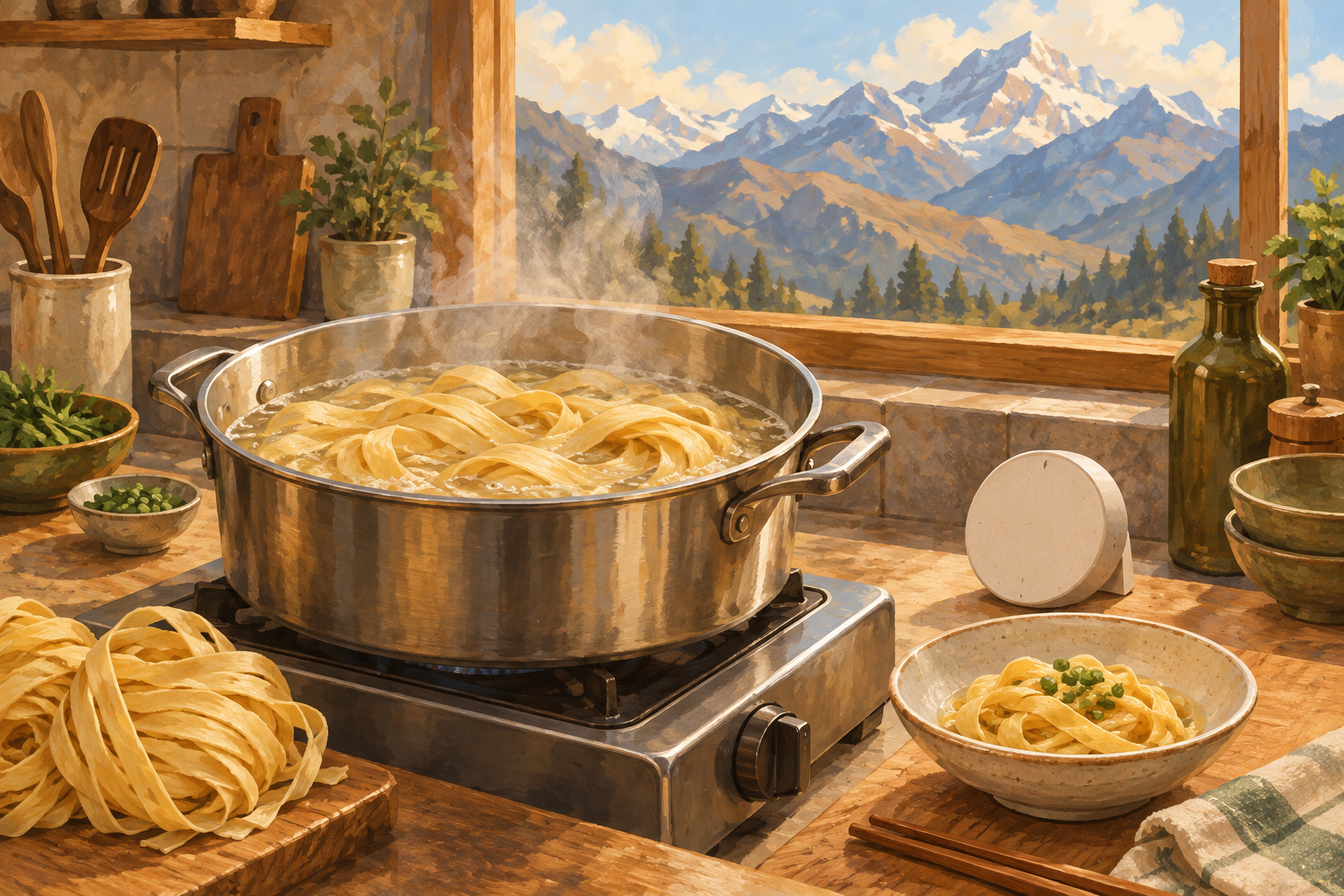
AI-generated editorial illustration of cooking noodles at altitude; not a tested recipe, measured cooking time or photograph of a Noodle House facility.
If noodles take longer to reach the desired texture in a high-altitude kitchen, turning up an already boiling open pot is not a reliable solution. The water can be boiling at a lower temperature than it does at sea level. Investigate the local cooking conditions before treating the timing difference as a product defect.
For a foodservice buyer, this is an application-test question. It does not justify changing the supplier’s instructions or publishing a new cooking claim without checking the exact product and method.
Boiling does not always mean the same temperature
USDA explains that lower atmospheric pressure at higher elevations lowers water’s boiling point. Foods cooked by boiling or simmering may therefore need longer. Once the open pot is boiling, increasing the heat mainly accelerates evaporation rather than raising the water above its boiling point. USDA high-altitude cooking guidance.
This physical difference can explain why the same timer setting does not produce the same noodle texture in two locations. It does not establish the correct new time. Product dimensions, batch size, equipment and the intended dish still need to be considered.
Compare the preparation methods before the samples
Imagine a distributor evaluates a noodle sample in a low-elevation kitchen, then sends it to a restaurant in a mountain location. The second kitchen reports a firmer centre at the original time.
Before asking the manufacturer to change the noodle, compare the sample identity, location, equipment, noodle quantity, water quantity and timing start. Determine whether one kitchen started its timer at noodle addition and the other at the return to boil. Record the local elevation and, where available, the observed water temperature using suitable equipment.
This is a hypothetical evaluation scenario. It does not describe a customer complaint or establish that any particular Noodle House product has been validated for high-altitude use.
Run a useful local trial
Ask the kitchen’s responsible food professional to begin with the applicable product instructions and plan the local evaluation. Keep the noodle quantity, pot, water and handling method consistent while recording texture at relevant points.
Record water loss as well as timing. Aggressive boiling can change the process by removing water faster. A test that changes heat, water volume and batch size simultaneously makes it harder to understand why the result changed.
The decision should describe the intended result: for example, the texture after the actual soup or stir-fry step. Do not approve a method solely because a strand tasted acceptable immediately after draining if that is not how the restaurant serves it.
Avoid a universal correction factor
Do not add the same number of minutes to every noodle SKU or assume every high-altitude kitchen needs an identical adjustment. Likewise, pressure equipment changes the conditions and must be used according to its manufacturer’s instructions; an open-pot observation should not be carried across unchanged.
Texture assessment is not a substitute for any applicable food-safety controls. The responsible operator must maintain the necessary safety requirements for the full dish and service process.
Use the cooking-test record guide to keep the observations reproducible. The portion-planning guide addresses the separate serving and yield decision.
For product evaluation, send the selected noodle, kitchen location, preparation method and intended dish through the contact page. Ask about the available product information rather than assuming a universal cooking-time guarantee.
Reviewed: 1 October 2026. This guide provides a comparison method, not validated instructions for a particular kitchen.