Buying Somen or Fine Wheat Noodles: Check the Category Before Comparing Samples
Compare the product category, dimensions and manufacturing evidence before treating a fine wheat noodle sample as somen or hand-stretched somen.
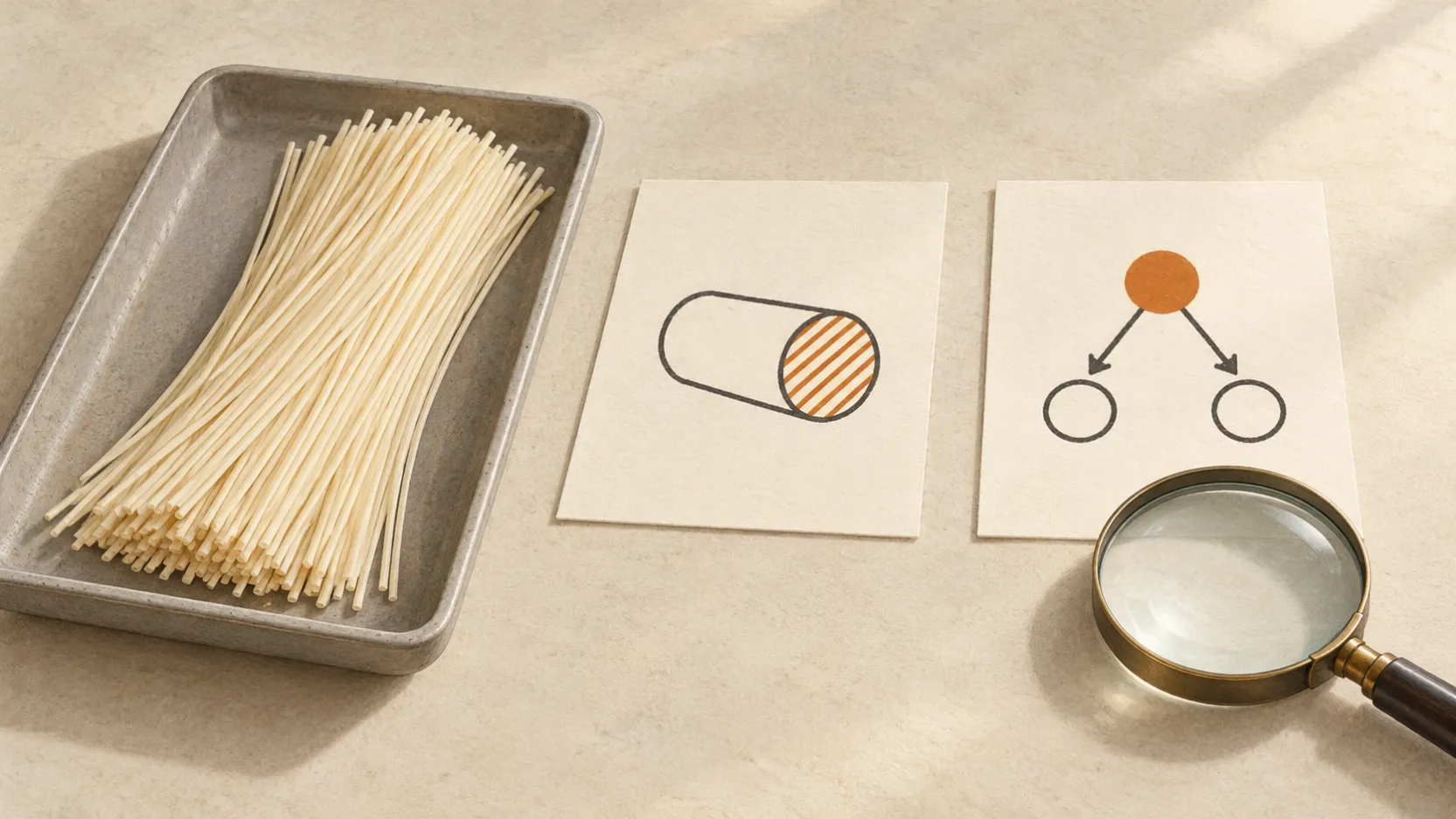
AI-generated editorial illustration of noodle specification review. The strands are generic and do not establish a product's dimensions or manufacturing category.
For an importer or private-label buyer, a request for “somen noodles” needs a more precise product definition than a photograph of fine white strands. Is the customer specifying a named Japanese noodle category, a hand-stretched product, or simply a thin wheat noodle for a menu? Those briefs require different evidence before a supplier's sample can be accepted.
Noodle House lists Amoy Flour Vermicelli and Fine and White Plain Noodle. These are starting points for a thin-wheat-noodle discussion. Their catalog names do not establish that they are somen or hand-stretched somen, and this guide does not present them as verified substitutes.
A diameter figure needs a category beside it
Japan's Ministry of Agriculture, Forestry and Fisheries includes two separate entries in its traditional-food introduction to grain products:
| Entry in the MAFF introduction | Diameter and shape shown | Production description shown |
|---|---|---|
| Somen | Diameter below 1.3 mm | Fresh somen is dried |
| Hand-stretched somen | Diameter below 1.7 mm; cylindrical | Oil is applied, the noodle is stretched while twisted, then dried |
These are descriptions in that Japanese introduction, not a universal naming rule or a certification of any offered product. The table should not be used by itself to approve market labeling.
Consider a hypothetical specification stating a 1.5 mm diameter. That number falls outside the first entry's diameter description and inside the second entry's range. It does not prove the second entry's production method or shape. This is an illustration of reading the table, not a measured Noodle House sample.
Ask for the evidence that resolves the actual mismatch
Suppose your customer's purchase brief expressly requires a hand-stretched noodle, but the offered sample has only a product photograph and a nominal diameter. Asking for another picture of thin strands does not close the gap. Ask for a manufacturing description tied to the exact product and reconcile it with the customer's requirement.
If the customer's requirement is instead functional—such as a fine wheat noodle for a particular dish—record that separately. You can then evaluate a candidate's cooking behavior and eating quality without assigning it an unsupported category name. Passing a menu trial and substantiating a production description are separate approvals.
A useful sample record keeps three items distinct:
- Identity: the exact supplier product name and SKU, together with any category or process claim requiring support.
- Dimensions: the supplier's specification and the sample measurements, identified by lot and measurement method. A photograph without scale is not a dimensional specification.
- Application: the customer's dish, the confirmed preparation instructions used, and the observations needed for the buying decision.
Do not invent a tolerance or a universal pass mark. Agree the customer's requirements before deciding whether a sample meets them.
Where our catalog products fit
Amoy Flour Vermicelli is described on our product page as a thin wheat noodle, with a catalog reference of 300 g per box and 40 boxes per carton. Fine and White Plain Noodle is listed at 284 g per bag and 40 bags per carton. Confirm current specifications for an order.
Those pack details identify what to discuss; they do not answer the manufacturing-category question. Neither cited product page establishes a somen classification, a hand-stretched process or the strand diameter needed to make that comparison. Avoid turning a similarity in appearance into an approved substitution.
For a fixed somen requirement, send the exact category and process wording so we can check whether the request matches an available product. For a broader thin-wheat-noodle requirement, identify the catalog candidate and intended dish so its current specification and sample instructions can be reviewed. Availability against a special requirement remains subject to confirmation.
Send your noodle selection brief, including the required product identity, whether the manufacturing method is mandatory, your destination market and proposed pack. This makes the first discussion about the product you actually need to buy.