Comparing Wheat Noodle Samples: Does Longer Water Cooling Always Improve Bite?
Compare wheat-noodle candidates under a workable water-cooling step. Longer contact does not necessarily improve bite; research findings are not a recipe for our products.
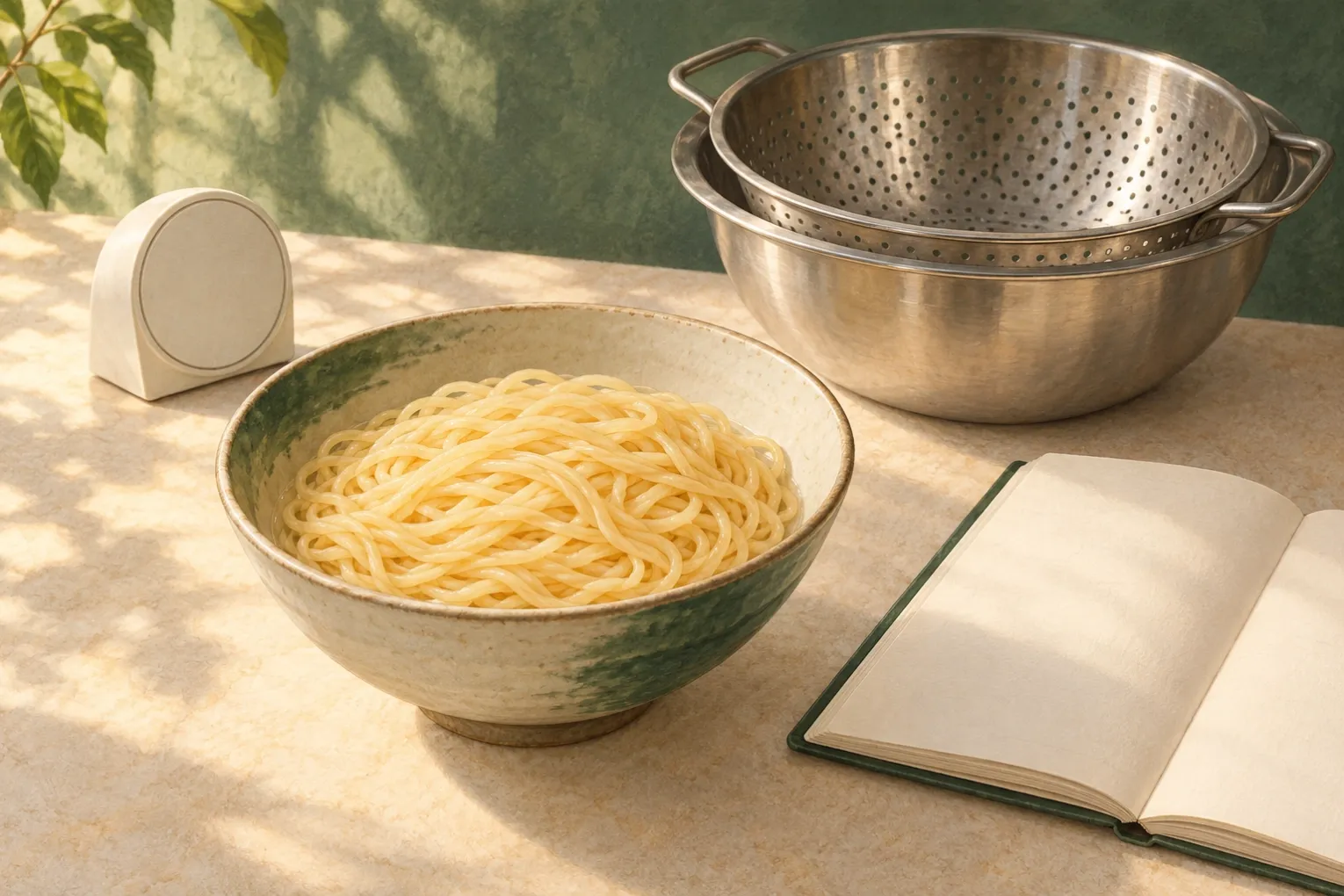
AI-generated editorial illustration of a noodle preparation setup; not a photograph of a company trial or a recommended cooling procedure.
Treat water-cooling time as a separate preparation variable when comparing noodle samples. Extending water contact is not a dependable way to keep improving bite. A product that meets your target only after an impractical cooling step may also be the wrong choice for your kitchen's process.
For a sample discussion, Noodle House Food's catalog lists Dried Noodles with wheat flour, water and salt, and Egg Noodle with egg as an additional listed ingredient. Both are listed as 454g bags, 30 bags per carton. These facts identify candidates; they do not establish which responds better to water cooling or whether either suits a particular cold dish. Confirm the current specification and preparation instructions for the samples supplied.
Cooling time can change the comparison
Liu and colleagues' 2024 study compared several water-cooling durations for experimental wheat noodles. Their reported texture improvements did not continue through the longest treatment: the 120-second condition showed increased free water and poorer texture than the preceding favorable condition. The authors examined changes in gluten structure as well as water distribution.
This is a reason to test the cooling step, not a recipe for our products. The published abstract and accessible methods excerpts describe laboratory noodles made from wheat flour and water. They do not establish a universal water-cooling duration, a food-safety cooling procedure or results for Noodle House products. In particular, the study's favorable 100-second condition is not our recommended preparation time.
Decide which process you can actually operate
Before requesting a different noodle, specify whether the kitchen's water-cooling step is fixed or adjustable. A fixed service routine calls for samples assessed within that routine. If the step can change, compare feasible alternatives before deciding that the noodle itself must change.
The following is a suggested sample evaluation, not a completed company trial. Keep any cooling and tasting within the kitchen's approved food-safety process.
- Start with one identified SKU and its documented cooking method. Keep the initial cook constant while comparing the cooling treatments.
- Define when water contact begins and ends. Record the water temperature, amount, agitation and draining method alongside contact duration. “Rinsed briefly” is not a reproducible treatment.
- Choose alternatives that staff could perform during normal service. Do not copy a laboratory duration simply because it appeared in a paper.
- Assess bite at the same intended serving stage. Record firmness and springiness separately from strand separation; a sample that loosens easily may still miss the desired bite.
- Repeat the feasible treatments before comparing another SKU using corresponding conditions. Keep the product identity and process attached to every judgment.
Choose a product and a workable preparation together
If a shorter feasible treatment meets the requirement and a longer one does not, retain that result as a bounded preparation finding. It does not prove a molecular cause or establish the best duration for every batch.
If an acceptable result requires a treatment the kitchen cannot consistently deliver, keep that operational limitation in the purchasing decision. Compare another confirmed candidate under the process you can support rather than approving a product on a one-off tasting result.
For broader controls, use our noodle cooking-test record guide. For the sample request, send Noodle House Food the product names, intended dish, feasible water-cooling steps and separate bite and separation observations. That makes the next discussion about a reproducible product-and-process fit, without promising that longer water cooling will solve the problem.